Awakening an Experimental Spirit for Oncology with Dr. Sean Khozin
Oncologist-scientist and CEORT CEO Dr. Sean Khozin continues his talk with DeepScribe CEO Matthew Ko, exploring how ambient AI can restore clinical intuition and shift oncology from reductionist workflows to more human-centered care.



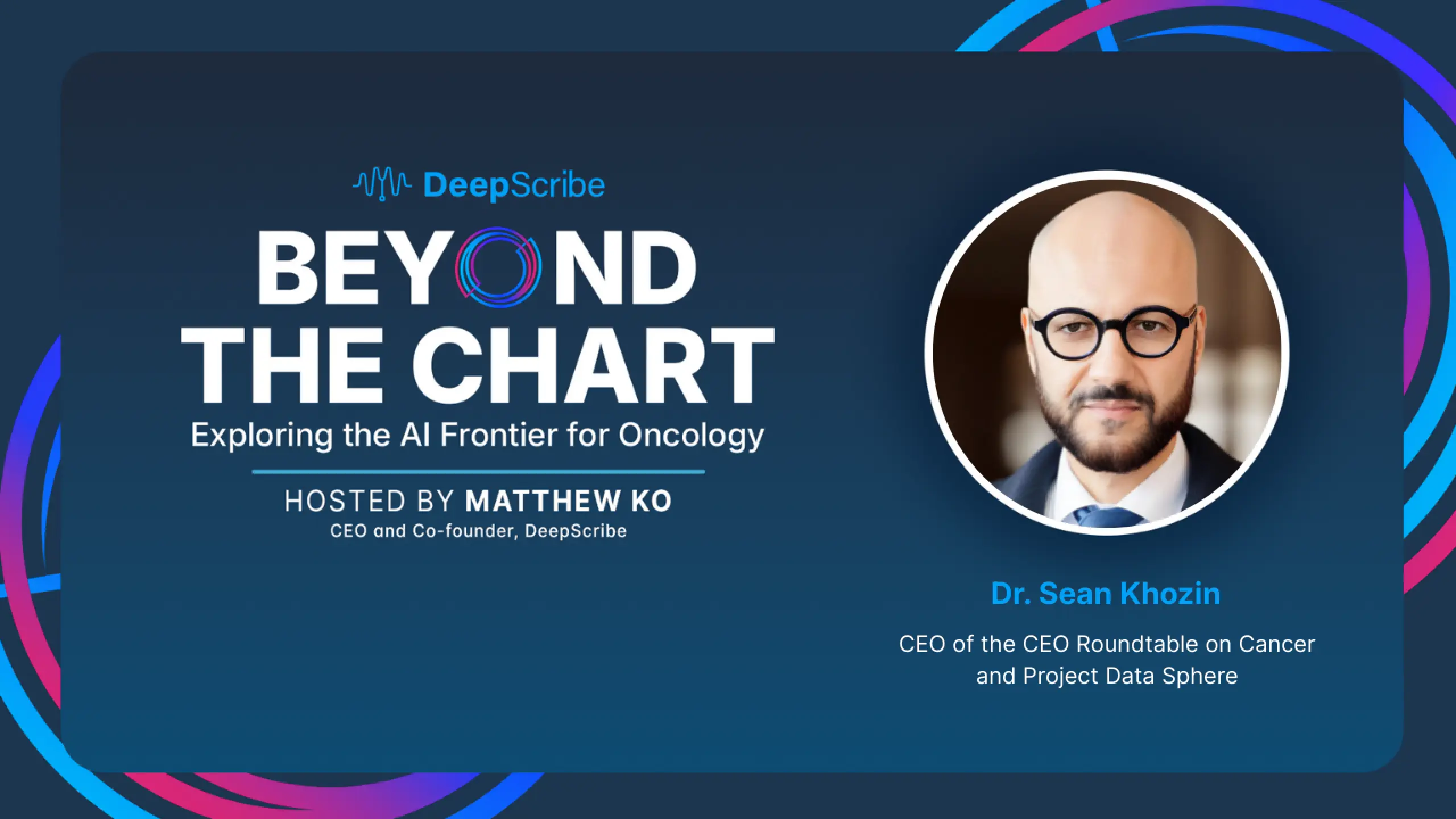
Guest
Dr. Sean Khozin, physician–scientist, executive, digital health innovator, and former FDA oncology leader; CEO of CEO Roundtable on Cancer, Project Data Sphere
Key Insights
The primary bottleneck for AI adoption in oncology is trust, not technical capability. Decades of technology fatigue from the EHR era have shaped clinician expectations. Ambient AI succeeds only when it measurably reduces cognitive load and restores presence.
Ambient AI can reconstruct clinical intuition by capturing rich semantic and behavioral signals. By structuring the natural language of patient encounters, ambient tools help clinicians access nuanced, longitudinal insights that typically remain locked in unstructured conversation.
Oncology needs a renewed experimental spirit to advance AI-driven care. Dr. Khozin emphasizes that clinicians historically thrived as experimenters and innovators, and that returning to this mindset is essential for adopting ambient AI, challenging outdated models, and unlocking more patient-centered decision-making.
Oncology must move beyond reductionist data models and outdated “gold standards.” Criteria like RECIST and legacy disease labels only simplify complex biology; ambient intelligence can surface more holistic, patient-centered indicators.
-------
How Clinician Trust Shapes AI Adoption in Oncology
Ambient AI appears to be the fastest-adopted technology in recent healthcare history. Yet its success hinges on something far more human than an algorithmic performance: trust.
Today’s clinicians carry the imprint of the early EHR era, years in which digital tools promised efficiency but delivered administrative overload. Dr. Sean Khozin summed it up during Part 2 of his conversation with DeepScribe CEO Matthew Ko on the Beyond the Chart podcast: “Physicians have had such a bad experience with electronic health records; they’ve become a little technology-hesitant.”
Ambient AI represents a fundamentally different approach. Instead of adding steps, it removes them. Instead of pulling attention away from patients, it returns it.
“If we focus on the doctor and the patient—because everything else is noise—we’ll see a completely new healthcare system.”
As clinicians feel the shift in their daily lives, trust grows. They experience fewer after-hours notes, fewer clicks, more eye contact, and more clarity. It’s that relief that builds trust, much more so than the “promise” of AI.
Why Oncology Needs a Return to Experimental Thinking
In Part 1 of his discussion on Beyond the Chart, Dr. Khozin talked about the deep historical connection between medicine and engineering. In Part 2, he explains why the spirit of experimentation in medicine has eroded: not because clinicians lost their curiosity, but because workflows became too brittle to support it.
“Physicians are not inherently afraid of technology. It just has to fit into their workflow.”
Across history, clinicians have embraced tools that have meaningfully improved patient care. As an eye-opening example, Dr. Khozin points out that the electrocardiogram was developed in the late 1800s, and “very quickly moved into patient care because clinicians and physicians were experimentalists.”
To understand and realize what can be accomplished in oncology’s next era, the reawakening of that experimental instinct is essential. Whether early imaging or robotic surgery systems, technology adoption has happened naturally when the tools have aligned with real clinical needs.
Ambient AI revives that alignment. It supports the way clinicians actually think and work, but does so through conversation, pattern recognition, and relational insight, not rigid interfaces.
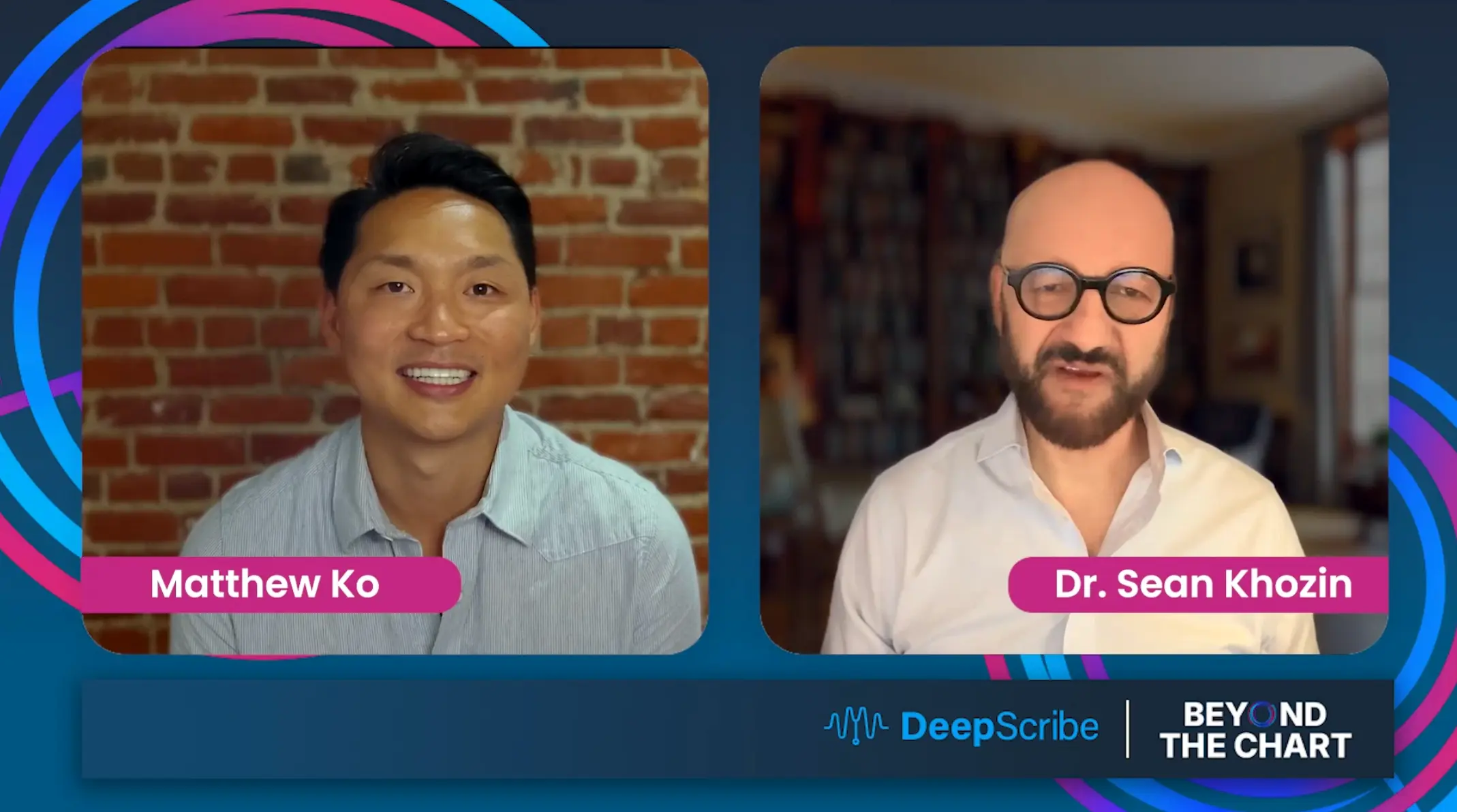
Watch the full episode: Awakening Medicine’s Experimental Spirit for the Future of Oncology
How Ambient AI Rebuilds Clinical Intuition in Cancer Care
Dr. Khozin introduces one of the most powerful concepts discussed on Beyond the Chart: the idea that ambient AI can reconstruct clinical intuition by capturing the full semantic richness of patient–clinician interactions.
Clinical intuition is a latent model built over time: the tone shifts, the subtle hesitations, the accumulated story. But in today’s environment of high volumes, high complexity, and high administrative load, that intuitive space is harder to maintain.
“Ambient AI gives clinicians access to the most informative and historically inaccessible data in medicine: the patient’s own words.”
By structuring natural conversation and longitudinal signals, ambient AI helps surface early indicators that clinicians would ordinarily recognize instinctively—if they had more time and fewer distractions.
Why Oncology Must Move Beyond Reductionist Data Models
Traditional clinical documentation is fundamentally reductionist, consisting of boxes, fields, templates, and narrow categories. These frameworks were designed not because they reflected the complexity of disease, far from it. They were what technology could support at the time.
Dr. Khozin draws on information theory to highlight the opportunity ahead:
“Messiness means entropy, and entropy contains the most information.”
For oncology, nuance matters. Patterns matter. Longitudinal shifts matter. But what you might consider the “messy” data—dialogue, emotion, semantic content—has historically been unreachable. Ambient AI changes that equation.
Because ambient AI can translate unstructured signals into structured intelligence, the richness that clinicians rely on is preserved, with insights that historically came only from long-term familiarity with each patient (and sometimes, their families).
This transformation beyond the conventional data models allows oncology workflows to become both more precise and more humane.
Rethinking Oncology’s Gold Standards: From RECIST to Real Signals
Perhaps Dr. Khozin’s most provocative argument is that oncology’s “gold standards” are not immutable truths, but starting points that must evolve.
He points to RECIST, the criteria used to measure tumor response in clinical trials. Although it’s foundational to drug development, as he explains, “nobody uses RECIST in the real world” of day-to-day cancer care.
“In oncology, there are no gold standards. Every standard is to be questioned.”
Today, clinicians combine imaging, symptoms, functional status, and intuition in ways that far exceed RECIST’s simplistic thresholds.
Even disease labels like “non–small cell lung cancer” were born from visual heuristics rather than biological mechanisms. These frameworks were practical in their time, but are incomplete.
For AI innovators, knowing this is critical. Building models on outdated labels risks reproducing outdated thinking. Ambient intelligence can open the door to richer, biologically and experientially grounded signals that clinicians actually use to make decisions.
What Smart AI Policy Should Prioritize for Oncology Innovation
As both the growth and usefulness of AI accelerates, many wonder whether healthcare needs a Meaningful Use–style mandate to ensure adoption. Dr. Khozin submits an unequivocal “no.”
The federal government, and the entire healthcare system in the U.S., learned difficult lessons in the HITECH era. Another top-down technology mandate would risk repeating the same mistakes.
But that doesn’t mean policy should stay hands-off. Creating and ensuring data liquidity across the biomedical ecosystem could have significant results.
“We need smart policy that empowers entrepreneurship. Organizing the best biomedical data responsibly could change the world.”
Effective policy should drive innovation without prescribing it:
- enable high-quality model development
- reduce fragmentation
- support clinicians rather than dictate workflows
The Future of Oncology: Restoring Presence Through Ambient Intelligence
With the episode wrapping up, Dr. Khozin and Matt return to the central question: What must change for oncology to become more humane, effective, and equitable?
It begins by restoring presence via ambient intelligence.
Ambient AI is already clearing valuable space for the relationship between clinician and patient, still the most powerful instrument in medicine—diagnostically and therapeutically
The next era of oncology will be shaped not by the volume of technology that’s introduced, but by how well it expands human understanding, precision, and connection.
text
Related Stories
Realize the full potential of Healthcare AI with DeepScribe
Explore how DeepScribe’s customizable ambient AI platform can help you save time, improve patient care, and maximize revenue.