The Ambient AI Success Formula: Building Trust and the Future of Ambient Data in Oncology with Dr. Ravi Parikh
Dr. Ravi Parikh of Emory’s Winship Cancer Institute talks with DeepScribe CEO Matthew Ko about the governance standards, partnerships, and ambient insights set to define the next era of AI in oncology.



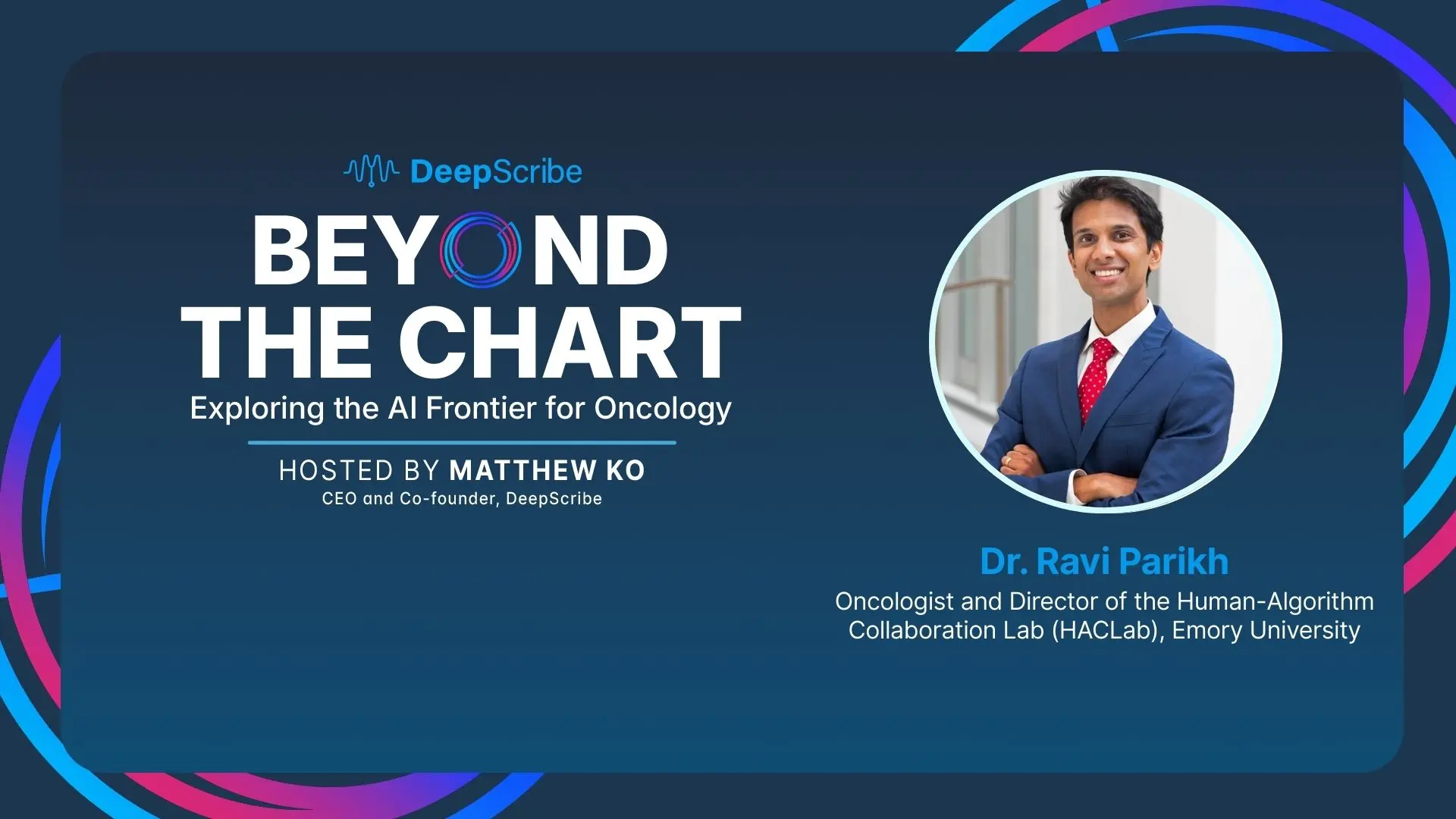
Guest
Dr. Ravi Parikh, MD, MPP
Oncologist and Associate Professor of Medicine, Winship Cancer Institute, Emory University; Director, Human-Algorithm Collaboration Lab (HACLab)
Key Insights
- An AI “trust gap” persists because vendors emphasize capability over evidence, while clinicians need proof of impact.
- In oncology, governance and partnership will determine which AI tools succeed.
- Ambient AI’s greatest value lies beyond documentation: structured conversational data could transform precision care.
- Community oncology practices are more versatile than academic medical centers at implementing new tools, with greater agility to shape how digital innovations evolve in cancer care.
For years, the promise of artificial intelligence has arrived at the front door of oncology clinics faster than the evidence to back it up. Few physicians see this tension more clearly than Dr. Ravi Parikh, whose professional life combines both direct patient care and rigorous AI evaluation.
In this episode of our Beyond the Chart podcast, Dr. Parikh talked with host Matthew Ko, DeepScribe founder and host, about the AI proposals that get in the door: They arrive in the form of polished capability and thin proof.
“Most of the pitches we get on AI focus on capability, and very little focuses on the evidence behind it.”
That asymmetry is why trust can often be missing even before a technology is put into place. Oncologists work in a complicated, convoluted medical specialty, not the controlled setting of a vendor’s technology performance.
Dr. Parikh argues that it’s not what a tool can do that matters, but what it can do in real life, and that it takes solid governance structures for health system leaders to evaluate that.
Building Trust in AI for Healthcare
Clinical AI is often discussed as if it will replace some aspects of care. Ambient AI offers a pathway that feels less risky: physicians remain fully in control of the clinical record, reviewing and editing each note. The tool supports and augments their work rather than reshaping (or even replacing) clinical judgment.
This distinction is crucial for trust, as is expert participation during the early adoption of AI for oncology. For Dr. Parikh, those are the times when clinicians want transparency, oversight, and clarity.
“We need predefined standards for AI governance in healthcare… right now every system is handling it differently.”
For ambient systems to scale, cancer care organizations need governance committees that include clinicians, ethicists, informaticists, and frontline staff. Without representation and accountability, even the safest tools lose momentum.
Beyond Documentation: What Ambient Data Makes Possible
Ambient AI has been widely celebrated for reducing documentation burden. But move beyond charting, and that’s what most excites both Dr. Parikh and Matthew Ko: Clinically rich, structured conversation data could unlock entirely new capabilities.

Today, oncology is filled with disconnected point solutions: genomic decision support, trial-matching software, pathway adherence tools, payer-preference engines. Each takes care of one problem, but none speak with each other. Dr. Parikh described the fragmentation as the biggest barrier to progress—and sees an ambient system as a possible solution.
“The ability to mine information from the record opens up a ton of different possibilities across a whole other set of use cases. It's super valuable.”
Ambient AI can create a unified, trusted data layer, built into the flow of clinical conversation. Once structured, that data can be linked to and integrated into genomics, treatment pathways, and payer considerations, surfacing insights directly at the point of care.
This in-the-moment information doesn’t appear as a separate screen or to-do task, but as a quiet layer of intelligence that supports decisions that clinicians are already making.
This is where ambient technology evolves to become the workflow operating system for coordinated oncology care.
Partnership: The Prerequisite for Innovation
In healthcare, technology rarely succeeds on technical merit alone; the real success is driven by the strength of partnerships. Dr. Parikh believes a focus on partnerships is where innovators and institutions have the most opportunity today. Transparency, shared data, and open collaboration build trust far faster than features.
“You need a partner you can speak to… someone who can show you usage data, performance, and what’s working or not working.”
This doesn’t happen through one-off deployments. It requires real relationships between health systems and vendors, relationships that allow for feedback, iteration, and a shared understanding of risk.
A Golden Window for Ambient AI in Oncology
As large EHR platforms begin introducing their own tools, Dr. Parikh sees the ambient AI landscape as changing rapidly. In this environment, switching costs rise and experimentation narrows.
Today’s ambient innovators have a rare moment in which to shape the future.
“There’s this golden opportunity right now. Once a solution is ingrained, we fight for it. We know that it’s useful and we don’t want to see it turned off.”
This window of time favors thoughtful, evidence-driven innovators who cultivate deep relationships with clinical leaders, and know how to build trust before they scale.
A Future Built on Responsible Intelligence
Despite the complexity of AI governance, Dr. Parikh remains hopeful about the value that oncology ambient data can bring to an institution: Better safety. Smoother coordination. A clearer understanding of each patient's journey.
Ambient AI also reduces clinicians’ cognitive load, often mentioned as a clear benefit of ambient documentation, helping clinicians recall details they might otherwise forget, and offering a more complete picture of care decisions.
In the end, the tools that earn trust will place the greatest emphasis on the humanity within oncology, helping clinicians not just stay present, but make the best decisions possible.
text
Related Stories
Realize the full potential of Healthcare AI with DeepScribe
Explore how DeepScribe’s customizable ambient AI platform can help you save time, improve patient care, and maximize revenue.