AI’s Role in Rebooting Oncology with Dr. Douglas Flora
An oncologist, cancer survivor, and the author of "Rebooting Cancer Care," Dr. Douglas Flora joins DeepScribe CEO and founder Matthew Ko to discuss where AI is already delivering value in oncology, why the path to clinical trust of AI begins in the back office, and why it’s essential for AI to understand the whole patient.



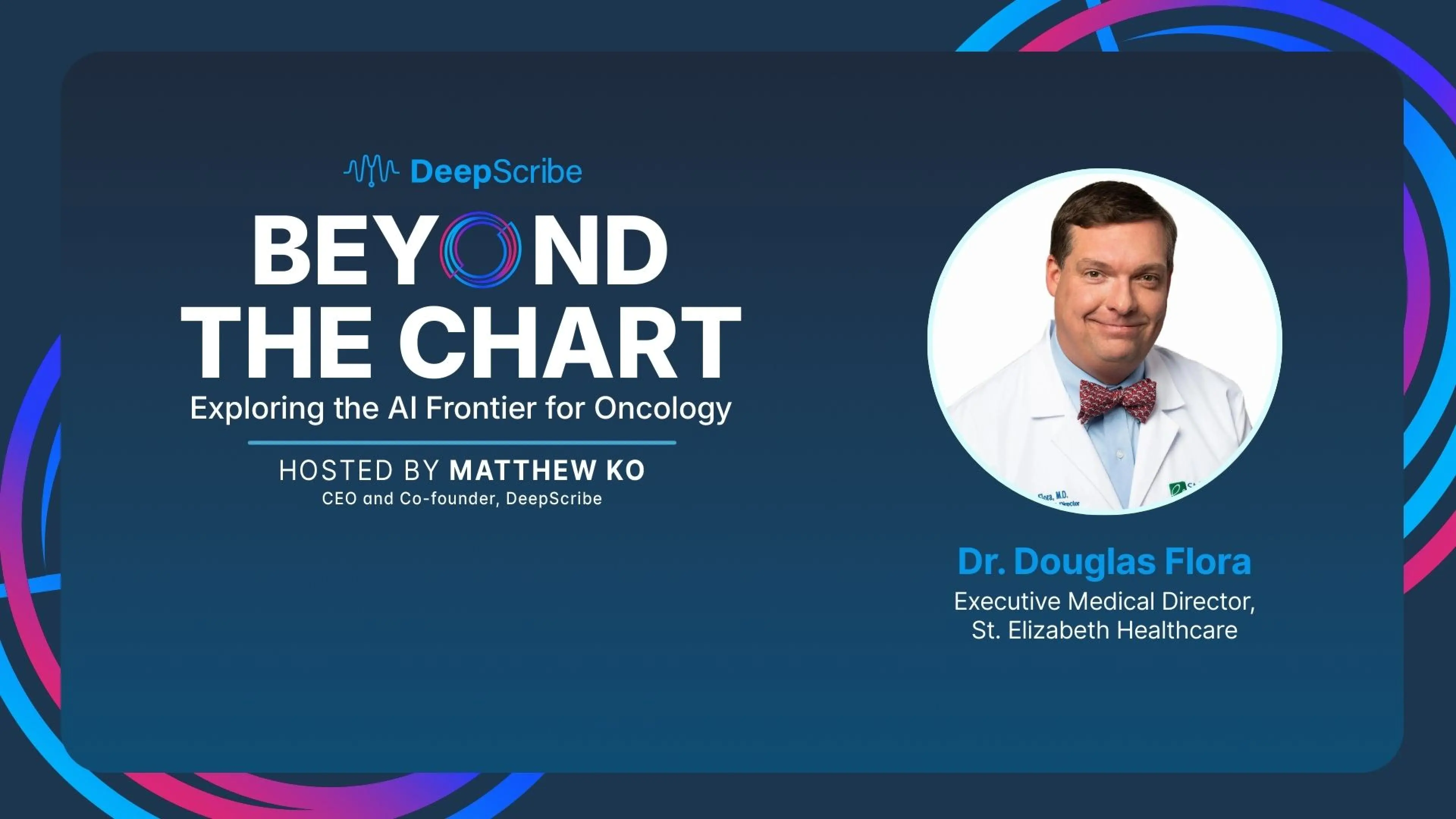
Guest
Dr. Douglas Flora, MD, LSSBB
Executive Medical Director, Yung Family Cancer Center at St. Elizabeth Healthcare; Editor-in-Chief, AI in Precision Oncology; President-Elect, Association of Cancer Care Centers (ACCC); CEO, TensorBlack
Key Insights
Ambient documentation is becoming "table stakes" in oncology. Organizations are already reporting significant time savings and closing charts before patients leave the building.
Building AI that oncologists trust requires deep partnership with clinicians. This is how clinical needs and nuances are understood—through sustained, embedded collaboration.
Pattern recognition AI in radiology and pathology has arrived. The technology is already augmenting sensitivity and specificity across cancer imaging.
The next frontier for ambient AI is agentic intelligence: nudging clinicians toward signals in longitudinal data that humans routinely miss.
Community oncology practices may adopt AI faster than academic centers. Community centers tend to encounter fewer bureaucratic barriers and have faster decision-making cycles.
Where Is AI Already Proving Its Value in Cancer Care?
Dr. Flora sees three areas where AI is either ready for widespread adoption or rapidly approaching it.
The first is ambient documentation. His own center at St. Elizabeth Healthcare is actively experimenting with ambient AI technology, and he points to results across the industry: Hundreds of physicians report spending less time in the patient chart and closing notes before the patient gets to the parking lot.
"We've seen lots and lots of centers with great success. Five hundred-plus doctors showing improvements in time spent, quality of life."
The second is pattern recognition. AI tools that assist radiologists and pathologists with digital slide analysis are here and producing measurable improvements. Clinicians who've used them have become vocal advocates.
The third area is emerging but represents the most transformative potential: AI that doesn't just record the clinical encounter but actively participates in it. Dr. Flora envisions tools that flag declining hemoglobin trends, catch unfulfilled orders, or surface symptoms mentioned across multiple visits. He describes this as moving from being "the recorder" to helping with "the whole orchestra."
Why Does Community Oncology Have an AI Adoption Edge?
One of the less discussed dynamics in healthcare AI is the adoption differences between community and academic settings. Dr. Flora sits at a unique intersection as St. Elizabeth operates elements of both models, and sees community practices moving faster.
"In the community, you can really get things done quickly. You don't have to go through giant bureaucracies of big hospital systems or big academic ivory towers."
Without the institutional layers common to large academic centers, community practices can pilot and deploy AI solutions on shorter timelines. The economic incentives align, too: community oncologists face the same workforce pressures as everyone else, but with fewer resources to absorb the strain. With cancer rates projected to double by 2030 while the oncologist supply stays flat, the urgency compounds.
For organizations already using ambient AI, that speed to deployment often translates into faster clinician adoption and quicker feedback loops with technology partners. These are exactly the conditions that produce better tools over time.

What Does It Take to Build AI That Oncologists Actually Trust?
One thread ran through much of the conversation between Dr. Flora and Matthew: the gap between what technologists think clinicians need and what they actually need. Dr. Flora is direct about where many vendors go wrong.
"A lot of vendors make the mistake of thinking that they deliver these turnkey solutions. They're not actually solving the things that we need solved."
He advocates for something more intensive than the typical vendor-customer dynamic. Instead, Dr. Flora promotes real partnership, where clinicians are embedded in the development process and engineers spend time observing the chaos of an actual clinic day. He co-founded TensorBlack in part to bridge this gap, providing fractional clinical advisory teams to health tech companies that need physicians who speak both medicine and engineering.
Dr. Flora has watched companies burn through their runway building solutions for problems that weren't in their customers' top twenty priorities. And he draws a sharp line for the technology needed in healthcare: in oncology, a minimum viable product needs to be polished to a degree that would look like a late-stage iteration in consumer tech.
How Does the Complexity of Oncology Challenge AI Design?
Dr. Flora offered two examples that illustrate why specialty-specific AI matters so much in this space.
In the first example, a patient's daughter is getting married. Talking about it during an encounter sounds like casual conversation, but the wedding date directly determines how aggressively Dr. Flora will pursue chemotherapy. As he puts it, for this patient walking his daughter down the aisle is "mission critical," and it shapes the treatment plan in ways that never appear in a progress note.
“There are things you can’t capture with a microphone. The patient’s daughter getting hives on her chest. The husband getting vagal two seats over. I can't teach your engineers that."
In the second, a patient lives on a houseboat three and a half hours away. Because she insists on making the drive to see Dr. Flora, he routinely selects a chemotherapy regimen administered every 28 days instead of weekly, which he calls likely “the fifth option on the list.” A clinical decision support system following standard algorithms would never surface that as the optimal choice.
These aren't edge cases. They represent the daily reality of oncology, where personal context shapes clinical decisions in ways that rigid systems can't accommodate. It's why customization and personalization aren't luxury features—they're requirements.
What Role Will AI Play in Early Cancer Detection?
The conversation shifted to one of Dr. Flora's areas of deep expertise: the emerging science of liquid biopsies and minimal residual disease (MRD) testing. As both a researcher and the Editor-in-Chief of AI in Precision Oncology, he brings a unique lens to the question of where detection technology is headed.
Dr. Flora believes MRD testing is ready for standard-of-care adoption now as the evidence base has reached critical mass. He points to breast cancer trials where patients whose MRD status shifted from negative to positive had their therapies escalated, and many returned to negative status with better outcomes.
Multi-cancer early detection (MCED) tests are further out. The first wave of commercial tests overpromised and underdelivered, leading to lawsuits and skepticism. But Dr. Flora remains bullish on the next generation, which will combine DNA methylation with chromosome fragments, metabolomics, and other biomarkers for a more comprehensive signal.
Where it gets most interesting for ambient AI is in Dr. Flora's vision of combining detection tools with the kind of longitudinal pattern recognition that ambient systems can provide.
He offered a compelling example: MCV (mean corpuscular volume) in routine blood work. A gradually falling MCV, even within the normal range, can signal iron deficiency that precedes a colon cancer diagnosis by eight to ten years.
"Your tool can poke me and say, 'Are you aware this MCV has fallen?' You probably just saved more lives than I can with chemotherapy."
This is the bridge between ambient documentation and clinical decision support: capturing not just what's said in today's visit but identifying patterns across years of data that clinicians, constrained by time and cognitive load, routinely miss.
What Do Technologists Need to Understand About Cancer Care?
Dr. Flora closed with a message aimed directly at the engineers building the next generation of healthcare AI.
He asks them to approach healthcare with the same enthusiasm they'd bring to an unsolvable proof. Don’t treat medicine as an impossible problem, just a harder one, and take bites that are chewable while the technology catches up.
He also puts the relationship between technologist and clinician in a perspective that can help one relate to the other: their time pressures. Oncologists are absorbing a decade of medical advances in a single year, just as engineering teams are racing to ship products amid rapidly shifting capabilities. The mutual dependence is real.
"We need you guys as badly as you need us. The more time those two rooms can spend together, probably the better for the final products."
His parting frame is one that resonates with DeepScribe's approach to building for oncology: this isn't about laying bricks. It's about building a cathedral. The mission is personal and that's a motivating truth for anyone in the room, from the patient and their family to technologists and engineers.
Where Is the Future of AI in Oncology?
Dr. Flora's perspective is shaped by something few in this space can claim: he's an oncologist, an administrator, and a cancer patient. That 360-degree view gives him a unique look at both the promise and the limitations of AI in cancer care.
- In the near term, ambient documentation becomes universal and non-negotiable.
- In the medium term, pattern recognition and coding intelligence become expectations rather than differentiators.
- At the longer horizon, ambient systems don't just capture what happened in the room but actively help clinicians navigate what should happen next.
Getting there requires the kind of partnership Dr. Flora is advocating for, where technology companies earn trust through back-office wins, collaborate deeply with clinicians, and avoid rushing past the threshold of what's actually ready for patient care.
As Dr. Flora writes in his book, the goal isn't to replace human judgment with computation. It's to lift the weight of computation so clinicians can return to what brought them to medicine in the first place.
text
Related Stories
Realize the full potential of Healthcare AI with DeepScribe
Explore how DeepScribe’s customizable ambient AI platform can help you save time, improve patient care, and maximize revenue.