The Familiarity Factor: What it Takes for Oncologists to Trust AI with Sanjay Juneja, MD
Dr. Juneja, a hematologist/medical oncologist and VP at Tempus, talks with DeepScribe CEO and founder Matthew Ko about what led to his social media following of 750,000+ people: simply sharing his expertise to close knowledge gaps. They discuss how AI addresses those same gaps today and what it will take for oncologists to adopt it.



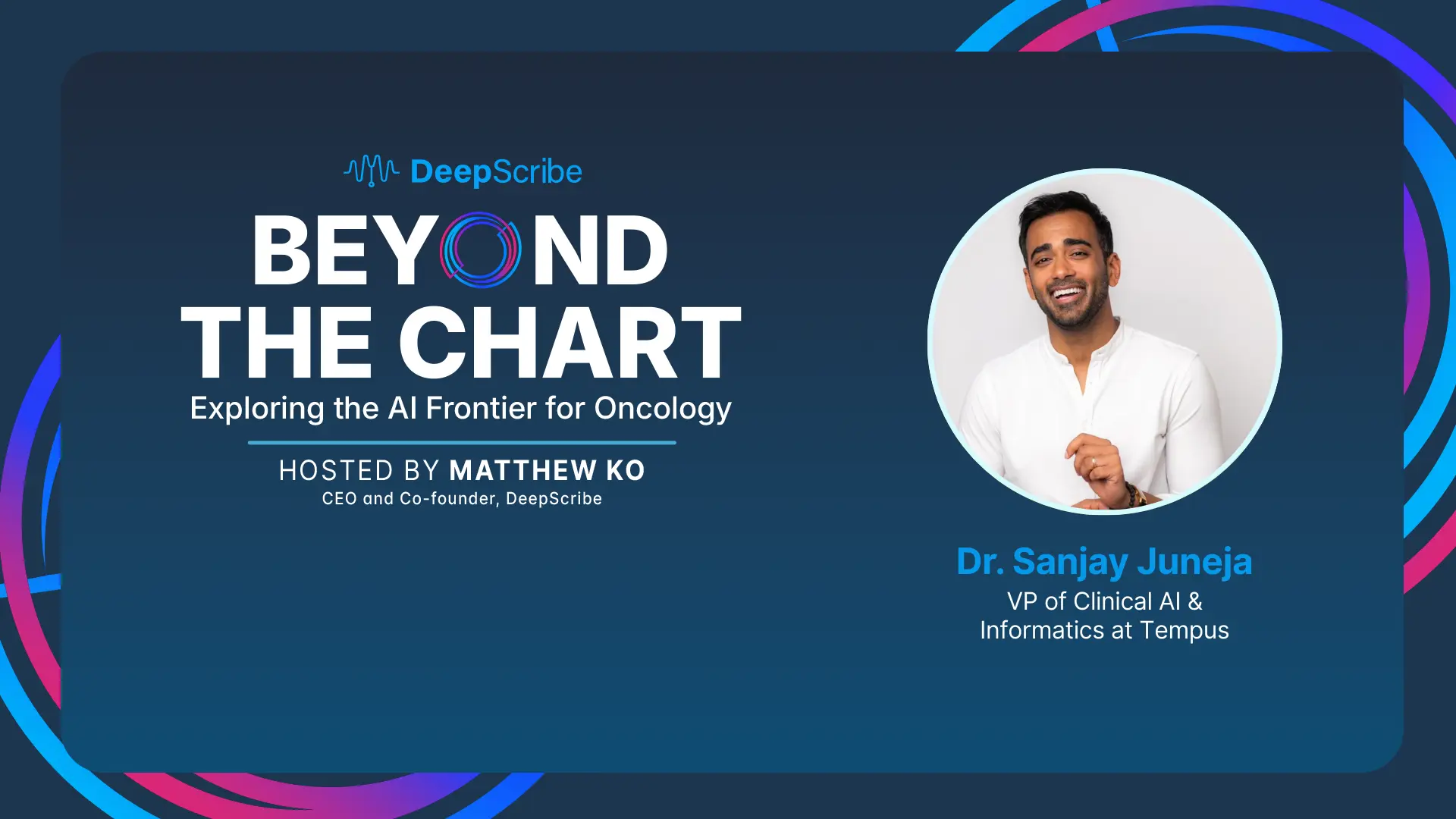
Beyond the Chart Podcast Guest
Sanjay Juneja, MD
Hematologist and Medical Oncologist; VP, Clinical AI & Informatics, Tempus; Co-Founder, Tensor Black; Founder, TheOncDoc
Dr. Juneja has built an audience of more than 750,000 learners across social media platforms by translating complex oncology concepts for patients and the public. Follow here for his work and cancer education content.
Key Insights
- Familiarity drives adoption more than functionality. Clinicians adopt AI tools when the output looks and feels like something they would have produced themselves, and not simply because the technology is superior. Formatting, language, and workflow fit matter as much as accuracy.
- The next wave of AI integration will be subtle. Dr. Juneja predicts the most impactful clinical AI will embed effortlessly into existing workflows, the way autocorrect or calendar suggestions arrived in smartphones. Clinicians will notice its absence before they would notice its presence.
- Context-sharing across the care chain is what makes AI genuinely useful. The real unlock in oncology is an infrastructure that passes information between systems in real time, so the physician knows before the patient leaves the room that a referral won't be available for two months.
- The standard for AI should be compared to current human performance, not perfection. Certain cancer screenings and molecular tests are ordered correctly only 15–20% of the time today. If AI can perform at 85–90%, the question shouldn’t be “Why isn't it perfect?” It should be “Why do we tolerate the current failure rate?”
- Oncologists should see themselves as co-designers, not end users. AI tools are malleable in ways that traditional software never was. Clinicians who engage now can shape the tools that future residents and fellows will use. But that window won't stay open indefinitely.
How did a practicing oncologist build a social media following of nearly a million people?
Dr. Juneja didn't set out to become one of oncology's most recognized public voices. He started posting online during his chief fellow year, motivated by the gap between how quickly cancer treatment guidelines were evolving and how reliably that information reached patients.
"The whole purpose was to empower patients to be their own best advocates. It never hurts to have both the patient participating and the physician having a top-level discussion."
What began as cancer education on social media became a place for Dr. Juneja to understand AI's potential. The access problems that inspired him to build an audience online are the same problems that well-deployed AI can begin to solve: fragmented information, overloaded specialists, patients navigating a system not built for them.
For Dr. Juneja, the connection became clear in 2023: He saw that generative AI and large language models could do more for medical information access than social media could— and could do it at scale. Maybe more important, AI would surface information without requiring patients or physicians to know what to search for.

Why do clinicians resist AI tools even when the value is obvious?
Matthew Ko and Dr. Juneja spend most of the podcast time discussing this question, and they land on an answer you might not expect. Clinician resistance is primarily due to a lack of familiarity.
It’s not that clinicians doubt the technology. They resist it because it disrupts a workflow they've spent years mastering. With that in mind, the value of any AI tool isn’t just about what it does or what problem it solves; in parallel, AI is judged on whether its actions already feel known or familiar.
"It's not just what can AI offer for you, but does it offer something that you are familiar with?"
Matt describes learning this at DeepScribe. The team built what they believed was a highly accurate AI system, only to find that clinical accuracy wasn't the primary lever for clinician adoption. What moved the needle was personalization: giving each individual provider the opportunity to customize the language model so it produced a note that was familiar, that looked and sounded like something they would have written themselves. The pronouns, the structure, the order of the assessment and plan… all were variables that determined whether a physician had a greater interest and trust in the output.
Dr. Juneja's analogy: Although plenty of people know that iPhone alternatives have arguably better technology, they still choose iPhones. It’s another case of familiarity being the adoption mechanism, and not just a soft consideration. Translated for ambient AI, the note has to feel like the physician's own to create that level of trust in what’s being generated.
What will AI actually look like inside clinical workflows?
Dr. Juneja predicts that near-term AI integration will not be marked by a single transformational shift. There won’t be a dramatic overhaul of how medicine is practiced. Instead, he describes a future where AI arrives in clinical settings the way software updates arrive on a phone: usefully, and largely unannounced.
"I think AI will be very subtly integrated pieces of the clinical workflow for a physician that just start happening."
He cited a conversation with a colleague about the friction of scheduling an endocrinology consult before starting lymphoma therapy. At one institution, the bottleneck was the days it took to coordinate the referral. At another, the wait for that referral was two to three months, long enough to force a complete change in the treatment plan. In either case, the physician didn't find out about the scenario until after the visit.
While it might be easy to assume a new referral protocol is needed, that’s not necessarily the solution. Instead, an ambient system that already knows the endocrinology calendar, surfaces the conflict before the patient leaves the room, and prompts the physician to adjust the plan. None of this requires a thread of text messages passing between staff members.
Matt describes this as a zero-latency context: a system doesn't just document the conversation, but understands what the conversation implies and acts on it. That is the direction the DeepScribe platform is taking, that of an infrastructure that passes context across the care chain and reduces the distance between a clinical decision and its execution.
When should AI in healthcare stop being optional?
The most philosophical portion of the conversation centers on a question Matt raises explicitly: At what point do AI tools stop being discretionary and instead become part of the standard of care?
Dr. Juneja grounds the answer in a striking clinical reality. Currently, low-dose CT lung cancer screening, an intervention with demonstrated survival benefit for qualifying patients, is ordered at a rate of only 15–20%. Certain molecular tests with the potential to guide treatment decisions simply aren't reaching the patients who need them, a failure of the current system that’s familiar and tolerated.
"We have to make this decision soon on whether we hold the standard of performance that a technology offers against its own category, or compare it to what the performance is today."
Dr. Juneja argues that the reluctance to adopt an AI solution is rooted in a philosophical bias: Humans tolerate their own fallibility at a far higher rate than they tolerate the fallibility of something they've created. That bias shapes how the medical community approaches AI. Putting hypothetical numbers to the concept, if AI can perform a given clinical task at 85–90%, asking why that number isn’t 99% isn’t the pertinent question. The real inquiry should be whether the current rate of 15–20% is acceptable.
Matt adds the economic dimension that liability for AI decisions currently lands on the provider organization, not on the entity that benefits from AI’s broad deployment. Resolving that structural barrier may ultimately require institutional or regulatory pressure. Both Matt and Dr. Juneja agree that the medical practices most likely to get ahead of the accountability question are those treating AI infrastructure as a strategic decision rather than a series of 30-day pilots.
What do oncologists and technologists need to understand about each other?
As with every episode of Beyond the Chart, Matt closes with a version of this question. Dr. Juneja has the experienced vantage point to answer both.
His word to technologists: Oncologists are unusually discerning. And that’s a feature, not a problem that needs to be addressed. For any oncologist, the devil is genuinely in the details, in ways it may not be in other areas of medicine. The implication for anyone building for oncology is that malleable, personalizable tools are the cost of entry, and not just a nice-to-have.
"To oncologists: You can participate today more than ever in the actual production and design of the very things that people in residency and fellowship today will be using."
To oncologists: AI tools are not rigid software. They learn, iterate, and respond to the clinicians who engage with them. As a comparison, Dr. Juneja points out how physicians historically evaluated technology, that a product was defined by how it performed on day one. That is not how modern AI works. The tools technologists are building today are shaped by the clinicians willing to engage with them now, and the window to do that is open in a way it won't always be.
For a specialty defined by precision and high stakes, that opportunity is considerable. The tools that define oncology's next decade are being built right now, and the oncologists who participate in that process will have a hand in making them their way, and the right way.
Subscribe to Beyond the Chart to be notified of future episodes.
Learn about DeepScribe’s ambient AI built for oncology.
You may also like:
Fixing the Access Gap in Oncology: Equity, Clinical Trials, and What AI Can't Solve Alone with Aparna Parikh, MD
AI’s Role in Rebooting Oncology with Dr. Douglas Flora
text
Related Stories
Realize the full potential of Healthcare AI with DeepScribe
Explore how DeepScribe’s customizable ambient AI platform can help you save time, improve patient care, and maximize revenue.