Two Brothers, Two Perspectives on AI Adoption with Rohit Gosain, MD and Rahul Gosain, MD, MBA
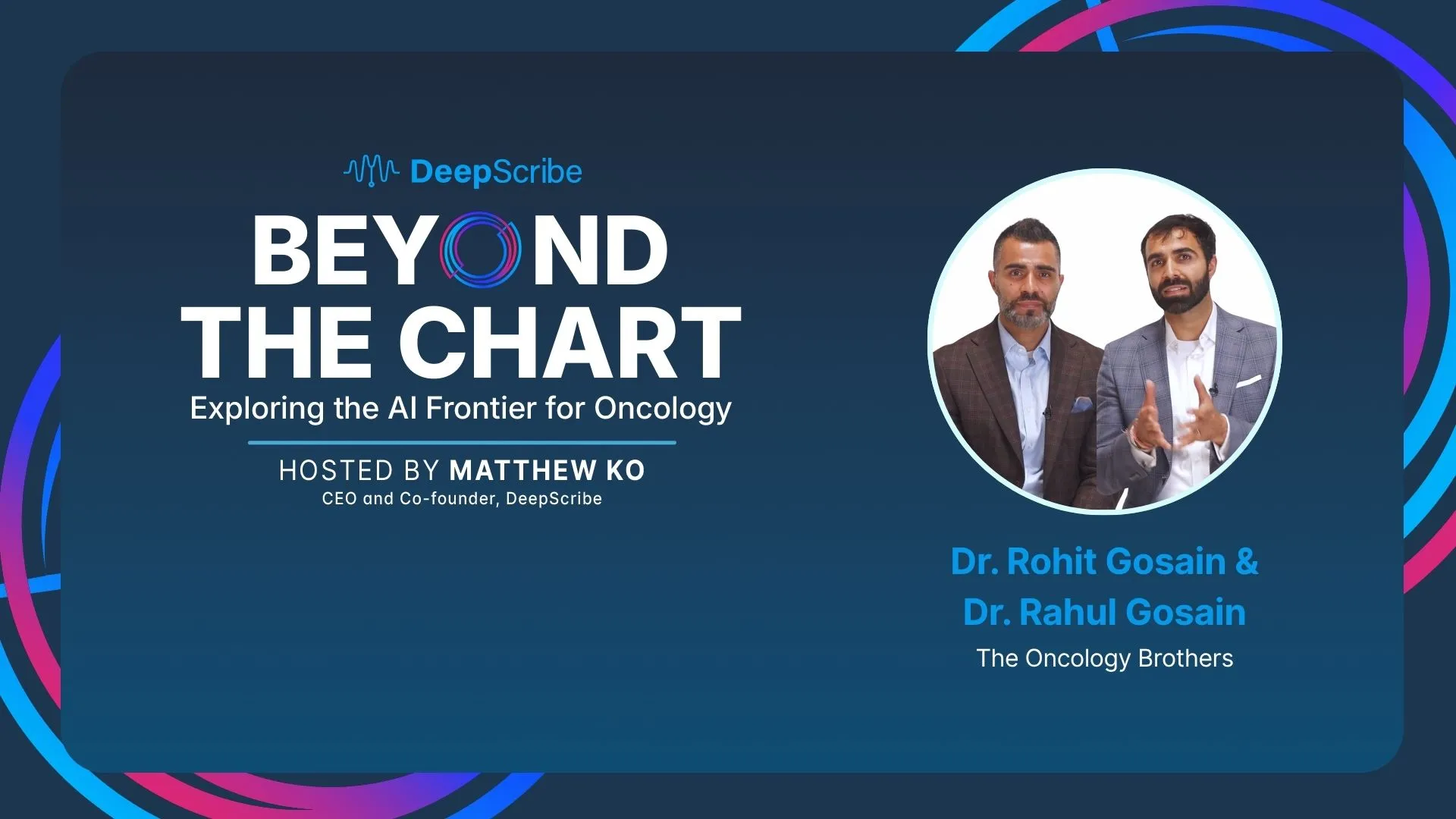
Dr. Rohit Gosain and Dr. Rahul Gosain, the physicians known as The Oncology Brothers, join DeepScribe CEO and founder Matthew Ko on Beyond the Chart to debate AI adoption in oncology: one brother already uses an ambient AI scribe, the other still isn't sold.



Beyond the Chart Podcast Guests
Rohit Gosain, MD Medical Director, Roswell Park Hematology Oncology Southtowns
Rahul Gosain, MD, MBA Medical Director, Wilmot Cancer Center at Webster
Key Insights
- Adoption doesn't happen because the technology is good. It happens because the first impression works. As Matthew Ko puts it, quoting his own mother, you can't make a first impression twice. For clinicians who tried an early, clunky version of an AI tool, that first bad experience is hard to undo.
- A self-described AI skeptic is likely skeptical of unproven tools, not AI. Dr. Rahul Gosain uses LLMs heavily but hasn't adopted an ambient scribe in his own practice. His motivation for adoption isn't what a big institution is doing; it's whether the tool makes him more efficient or improves outcomes for his patients.
- Community oncology needs oncology-specific AI, not a multi-specialty compromise. Academic medical centers often choose AI tools that have to work across every department at once. Community practices are freer to select something built for the details of cancer care specifically.
- The biggest opportunity for AI in oncology is closing the gap between what science knows and what reaches the patient. From flagging clinical trial eligibility to catching toxicity risks before they escalate, the conversation on this episode keeps returning to use cases well beyond the AI-scribed note.
How did two practicing oncologists become The Oncology Brothers?
The Oncology Brothers' podcast started in response to what feels like an insurmountable volume of information for an oncologist. Dr. Rahul Gosain took his first job as a community oncologist and immediately hit what he called data overload: new research was constantly emerging, but with no clear way to translate it into what to do for the patient sitting in front of him.
Shortly after, his brother Rohit found himself in the same position. The two started talking it through on long commutes, sometimes one-and-a-half to two hours a day, hashing out how new data should change their practice.
"We are ASCO Post-subscribed, we are NEJM members, JAMA-subscribed, and we are reading so much. Despite that, we are drowning. We can't be the only ones.” — Dr. Rohit Gosain
Eventually those phone conversations hit a ceiling.
"There's only so much that we can bounce back and forth with each other," Rahul explains, so the brothers moved the discussion to social media, then to a podcast. They deliberately created a bite-sized format: 15 to 20 minutes of conversation, distilled from research the brothers were already reading anyway, aimed at community oncologists who didn't have time to read every journal.
The brothers bring a blend of skills and know-how to the partnership. Rohit has a computer engineering background and Rahul has an MBA in addition to his MD. That mix shows up in how they talk about technology. "Every time I've talked about an idea to Rahul," Rohit says, "he's like, 'Rohit, you just need to break it down for me,'" half-joking that convincing his own brother is often harder than convincing an audience of thousands.
Why does one Gosain brother use an AI scribe and the other doesn't?
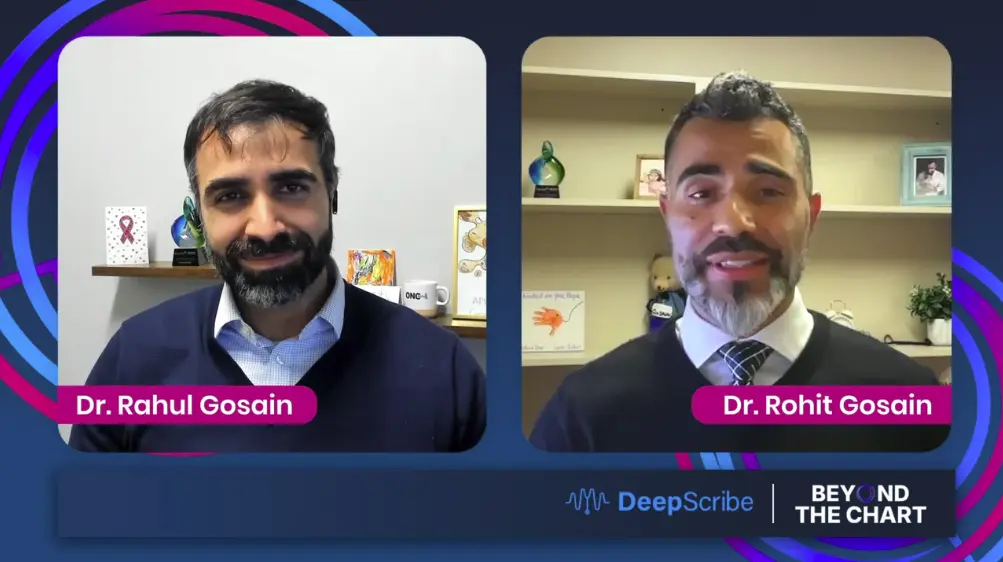
Rohit has been using DeepScribe in his own practice and describes two concrete ambient AI benefits: it captures details he'd otherwise lose between the visit and writing the note days later, down to small things like a referring physician's name or a medication change mentioned in passing, and it automatically ties documentation to billing codes. "It just eases off a lot of the documentation," Rohit says, "more than anything."
Rahul opts to continue dictating or typing his notes. He's not against AI broadly, and is a heavy user of LLMs for research and summarization. But an early experience with an AI scribe left him cold. "Those were not my words. Those were not my thoughts," Rahul says of the draft notes that the initial AI scribe produced. "It was filling in gaps that I did not think sounded like me."
"Nothing's black and white, oncology being a perfect example." — Dr. Rahul Gosain
The contrast of ambient AI use between the two brothers, practicing with different workflows, underlies the very concept of AI documentation adoption: more than whether the tool "works," adoption often depends on whether it sounds like the person using it. If the clinical note is a reflection of the clinician's approach and commitment to their patient, the more personalized the note, the better.
What does it take for a skeptical oncologist to trust AI?
What proof would move Rahul toward trying and adopting AI? Matthew Ko asks that very question, and Rahul's answer isn't about a specific study or benchmark. The true green light for Rahul is a mix of trust, comfort, and institutional signal, such as a health system broadly enrolling physicians or a large group making a tool available to everyone, not just early adopters.
"A lot of it is trust, a lot of it is comfort, a lot of it is also somewhat driven through institutions saying broadly we're making this available to all our physicians." — Dr. Rahul Gosain
Matt Ko points out that DeepScribe has seen this play out across healthcare technology adoption: the tools that succeed aren't necessarily the most capable ones. Instead, it's those that get the first impression right because clinicians rarely give a second chance to a tool that stumbled the first time.
That's part of why DeepScribe has leaned on what Ko calls "people at the elbow": support staff physically embedded with practices so clinicians have someone to ask questions and talk with while they're still building trust in the tool.
How is AI adoption different between community oncology settings and academic centers?
As practiced podcast hosts, Drs. Rohit and Rahul occasionally turn the tables to ask Matt questions, and Rohit asks this one directly. Matt's answer centers on a structural difference: large academic cancer centers typically evaluate AI tools against what works for the entire institution, not just oncology. Community practices don't have that constraint and can choose something purpose-built for their specialty.
That specificity matters more in oncology than in most fields. Rohit points out that when a patient comes in for a follow-up, the physician needs the oncologic history, not just the most recent note.
The ability for an oncology-specific ambient AI system to get into finer specialty focus has been proven with published data about DeepScribe use: an abstract with the Journal of Clinical Pathways showed a 45% increase in social determinants of health captured in notes and a 22% increase in comorbidities captured. Oncologists may not often document these categories because they're focused on the cancer itself.
With more than 70% of cancer patients treated in community settings, the stakes of getting this right, and making it part of the usual standard of care, are considerable.
Where is AI creating real value in oncology beyond documentation?
Both Rohit and Rahul push the conversation past AI documentation. Rahul raises clinical trial access directly, as patients will travel long distances to an academic center for a trial, only to be told they don't qualify. He sees an opportunity for AI to help match patients to trials earlier and more accurately, using the same data that companies like Tempus, FoundationOne, and Caris already generate for research purposes.
Matt discusses seeing tools that screen patient records against trial inclusion and exclusion criteria before a case ever reaches a research coordinator, so staff spend their time on the patients most likely to qualify rather than manually screening everyone.
"We've all had this: I refer a patient who's traveling hundreds or thousands of miles to see someone at an academic institution, and it's, 'Hey, there's this clinical trial, but oops, I'm sorry, you're not the right match.'" — Dr. Rahul Gosain
He frames the underlying problem in two parts: healthcare fails either because the science doesn't exist yet, or because the science exists but doesn't reach the clinician in time. With oncology seeing 40 to 50 new drug approvals and indications every year, and roughly 80% of pharma R&D dollars flowing into cancer research, Matt argues the second failure mode is the more urgent one to solve.
Rohit adds that expediting clinical trial accrual specifically in community settings, pointing to work already underway at groups like Sarah Cannon Research Institute, would be one of the highest-value applications he could imagine, precisely because community oncologists currently have less capacity to run trials than their academic counterparts.
What do oncologists wish technologists understood about their workflow?
Rohit's answer traces back to his own computer engineering background, having the ability to experiment with new AI models as they emerge. However, he is careful to note that this comfort with technology isn't the same as certainty about which tools deserve adoption.
Rahul's answer is simpler and, in a way, the whole episode in one line: keep the patient at the center. Whatever the tool, whatever the adoption curve, the measure that matters is whether it leads to better outcomes and more time for the relationships that brought most oncologists into the field in the first place.
Matthew Ko closes by half-jokingly promising to get Rahul using an ambient scribe before their next conversation. Whether that happens or not, the debate between brothers captures a useful and resonant fact: with the current speed of oncology, AI adoption is earned one honest first impression at a time.
Subscribe to Beyond the Chart to be notified of future episodes.
Learn about DeepScribe’s ambient AI built for oncology.
You may also like:
The Familiarity Factor: What it Takes for Oncologists to Trust AI with Sanjay Juneja, MD
The Ambient AI Success Formula: Building Trust and the Future of Ambient Data in Oncology with Dr. Ravi Parikh
text
Related Stories
Realize the full potential of Healthcare AI with DeepScribe
Explore how DeepScribe’s customizable ambient AI platform can help you save time, improve patient care, and maximize revenue.