Startup Thinking Meets Scientific Research in Oncology with Alicia Zhou, PhD
CEO of the Cancer Research Institute, Dr. Zhou talks with DeepScribe CEO and founder Matthew Ko about blending biology and technology successfully, and how her operating principles for startups are now shaping an ambitious AI-enabled research initiative in cancer immunology.



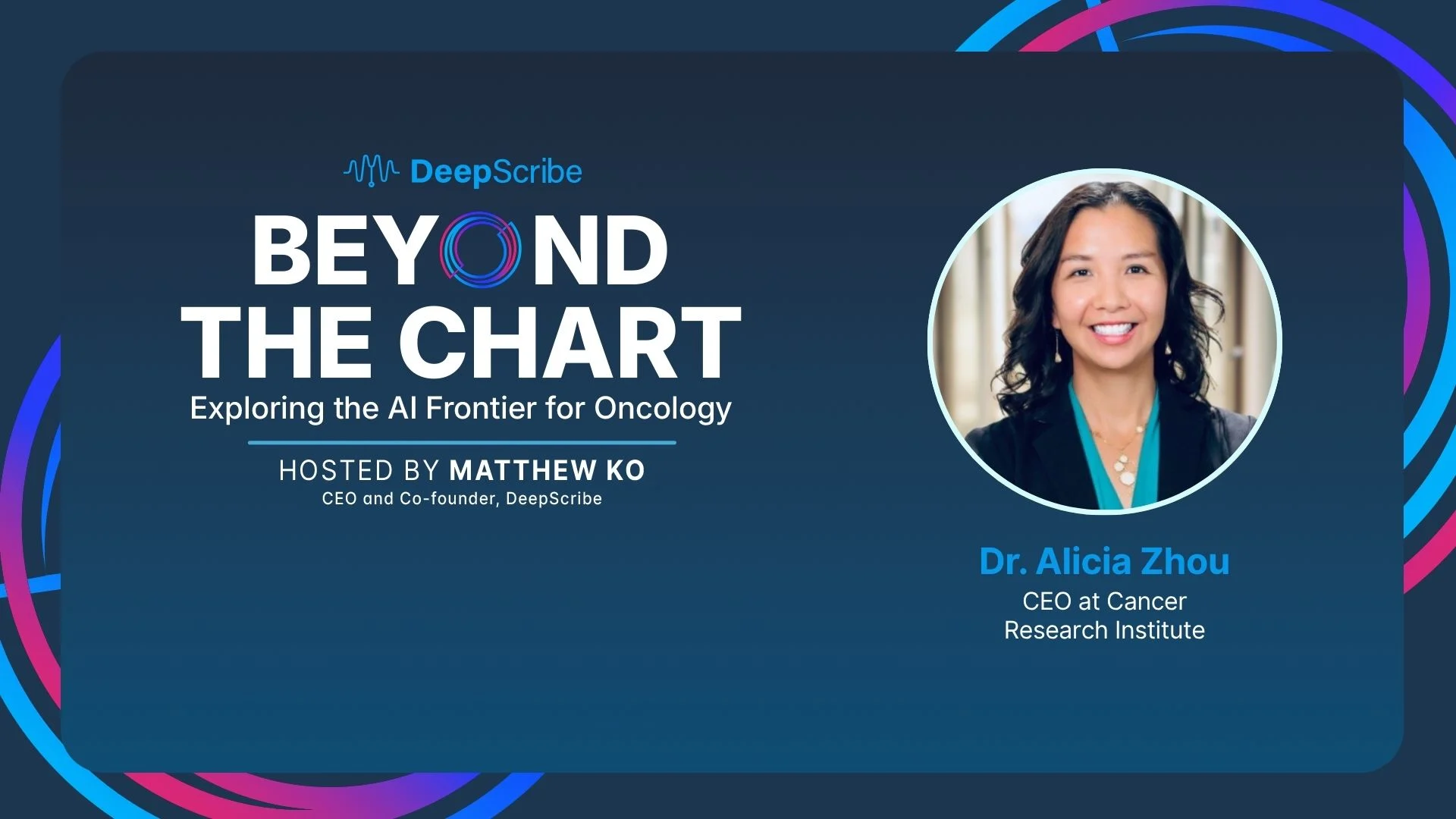
Beyond the Chart Podcast Guest
Alicia Zhou, PhD
CEO, Cancer Research Institute; Former Chief Science Officer, Color Health
Key Insights
- Speed is the only real advantage a startup has. When incumbents have more cash, more brand, and more runway, the only edge for a smaller player is agility. Dr. Zhou argues that protecting that speed, and hiring people who thrive in uncertainty, separates startups that move from those that stall.
- Cross-disciplinary humility is non-negotiable. The most common failure mode in health tech is when either side of the house—science or technology—fails to respect the other. Mutual humility becomes the prerequisite for collaboration, and collaboration is the prerequisite for building anything that actually works.
- Uncertainty is an opportunity. Dr. Zhou reframes instability as the condition under which disruption becomes possible. Incumbents tend to slow down in uncertain environments, and startups that lean into that unknown gain ground.
- In foundational research, data quality beats data quantity. To build the kind of ground truth dataset that can train reliable AI models in biology, Dr. Zhou is optimizing for depth and rigor over scale and breadth. This is a deliberate choice informed by her experience across multiple large-scale genomics initiatives.
- The data architecture decision is a cross-functional one. The way you structure biological data shapes which models can learn from it. Technologists need a seat at the table along with biologists when those foundational decisions are made.
What does it actually take to build a health tech startup?
Alicia Zhou didn't arrive in the startup world through the usual routes; as a result, she tends to view the landscape with a wider lens.
She spent years as a bench scientist in cancer biology before making the jump into industry, a transition she describes as anything but inevitable. With nearly a decade at Color Health (about five as Chief Science Officer), Dr. Zhou found that, as a company, they got something right from the start: bringing together deep expertise from both the technology side and the biology side, in the same room at the same time.
“Either you start on the biology side or the technology side. Then you have to very quickly acquire the right talent on the other side of the aisle.”
That balance, she told Matthew Ko, is rarer than it sounds. But Dr. Zhou credits much of what the company was able to build to Color's early commitment to bringing together people from both those worlds and creating genuine collaboration between them.
For scientists making a similar transition into helping develop a startup, Dr. Zhou has a pointed observation: Biologists tend to underestimate how much technology matters. The science may be what makes the product possible, but the technology is what makes it a product. "The product will not succeed as a product if you don't embrace the technology side."

Why hire people with a tolerance for uncertainty?
When Matthew Ko asked Dr. Zhou how she operationalizes urgency inside an organization, she pointed to something that doesn't show up on a résumé: the ability to embrace (or, as she says, “metabolize”) uncertainty. Competence is a must. But people most likely to help a startup move fast are those who can function, and ideally thrive, when the parameters are underspecified and the path forward isn't clear.
"There are people who are super, super competent, but shy away from the speed and the uncertainty," she said. Dr. Zhou looks for those who treat ambiguity as an opportunity rather than an obstacle.
"Uncertainty is the time when opportunities become available for disruption. If your job is to disrupt, you actually want to lean into the uncertainty."
This thinking extends to how Dr. Zhou considers broad market conditions. The last decade has delivered one unprecedented disruption after another: a global pandemic, a funding environment that has stumbled unpredictably and, of course, a technological shift driven by AI that is still playing out.
To her mind, we’ve been “in an unprecedented time for an unprecedented amount of time. At some point you have to say, this is the norm." For a startup, that means leaning into instability rather than waiting for it to pass—that’s how you operationalize urgency. The market leader may take longer to respond. The smaller, faster player that acts decisively gains ground.
What is the CRI Discovery Engine for cancer research, and how does AI come into play?
A recurring theme throughout Dr. Zhou’s career has been the relationship between biology and data; specifically, the way rich, well-structured datasets can change what's possible in research. She saw it when the Cancer Genome Atlas reshaped how scientists understood tumor biology. She saw it again through her work with the National Institutes of Health’s All of Us program. When she joined the Cancer Research Institute as CEO in 2024, she brought those experiences and that perspective with her.
“I hope dozens of different players—in academia, in industry, even hobbyists—use the CRI Discovery Engine data to train their own different types of models for their own particular use cases.”
The result is the CRI Discovery Engine: an initiative to build a high-quality, longitudinal dataset in cancer immunology that’s designed to support the training of AI foundation models. The immune system is dynamic and deeply complex, with hundreds of cell types interacting with one another, behaving differently depending on what's perturbing them. Studying this environment in a static snapshot misses most of what matters. To solve this, the Discovery Engine is designed to capture biology in motion, seeing how cells behave over time and in space, as treatments interact with the cancer.
The goal of the CRI Discovery Engine isn't to build one model or one product. It's to generate the foundational data that many researchers can use to build their own, training their models to fit their own use cases.
How close is AI to autonomous drug discovery?
Matthew Ko raised a question for research leaders that sits at the precipice of where AI in science is heading: Could a foundation model eventually take a prompt and return a cure? Dr. Zhou confirmed that cancer research is far from that and identified the inherent gap. It’s in our biology knowledge.
There are vast areas of human biology where the science itself is still incomplete, where researchers are still mapping basic mechanisms and don't yet have the ground truth needed to train a model that could reliably predict outcomes. Without that grounding, a foundation model operating in those spaces is essentially imagining, without a feedback loop to distinguish a true prediction from a plausible-sounding hallucination.
"We've barely scratched the surface of human knowledge of biology. There's so much unknown that if you let a foundation model just imagine, there's just the inability to reinforce it."
She pointed to the award-winning AI system AlphaFold as an instructive example of what works: a system that pairs bounded constraints—the laws of physics and biology—with an unconstrained imagination. The combination is essential, as Dr. Zhou explains, because a tight boundary limits that imagination (in this case, the ways a protein can fold), and a limitless endeavor dreams up conditions that are impossible, biologically and physically. That tension is where the productive work in AI-enabled biology lives.
How do you build a biological dataset where AI can make a difference?
The answer starts with who's in the room. For instance, Dr. Zhou feels that biologists will design a dataset optimized for the way they already think about biology. That makes sense, and it’s not necessarily wrong, but it leaves something on the table.
Technologists bring a different perspective, seeing features where biologists may see noise, and they'll ask different questions about what the data can support. “Technologists don't subscribe to the religion of biology," Dr. Zhou said. “They're going to add what the utility of different features might be for them long-term." With that input coming in early, a team has far less risk of discarding data that could matter for the models being built on top of it.
Getting the data architecture right requires the same thing Dr. Zhou has argued is essential to building any health tech company: scientists and technologists working together, each bringing humility about what they don't know and respect for what the other side does. It’s a topic of conversation that Matthew Ko works into every episode of Beyond the Chart—in this case, it’s one line of expertise for this particular guest. For Alicia Zhou, this cross-disciplinary collaboration, speed, and a tolerance for uncertainty are the conditions under which anything worth building becomes possible.
Subscribe to Beyond the Chart to be notified of future episodes.
Learn about DeepScribe’s ambient AI built for oncology.
You may also like:
Awakening an Experimental Spirit for Oncology with Dr. Sean Khozin
How Ambient AI is Improving Provider Collaboration
text
Related Stories
Realize the full potential of Healthcare AI with DeepScribe
Explore how DeepScribe’s customizable ambient AI platform can help you save time, improve patient care, and maximize revenue.