The Other Side of Cancer Care: Survivorship, Communication, and AI's Potential with Dr. Lidia Schapira
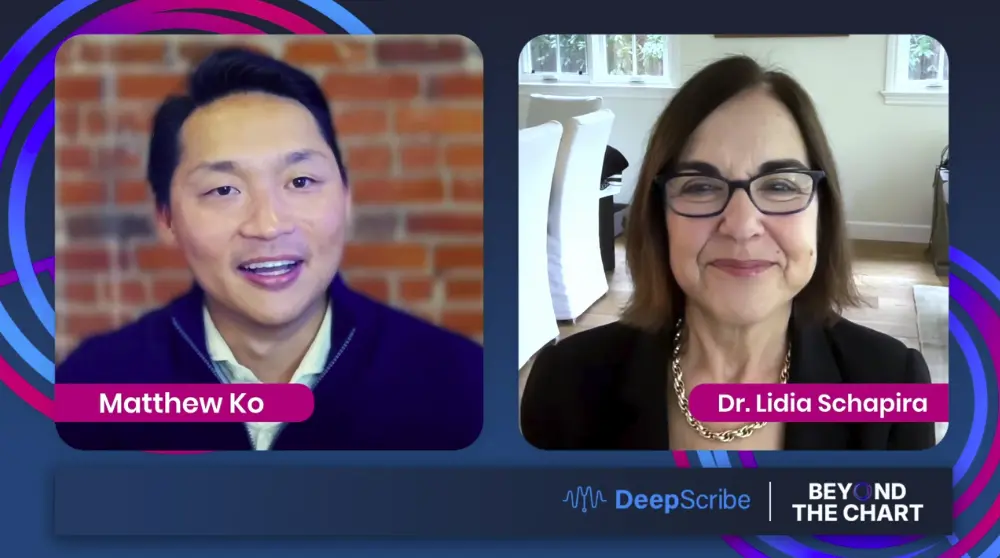
A specialist in psychosocial oncology and cancer survivorship, Dr. Lidia Schapira joins DeepScribe CEO and founder Matthew Ko to explore what oncology misses after treatment ends, and where AI can help.




Beyond the Chart Podcast Guest
Lidia Schapira, MD, medical oncologist
Professor of Medicine and Director, Cancer Survivorship Program, Stanford University; former Editor-in-Chief, Cancer.net (2015-2021) (ASCO's patient education platform); former editor, Art of Oncology section, Journal of Clinical Oncology (2013-2023).
Key Insights
- Survivorship care requires a fundamentally different clinical conversation than disease-focused oncology. Standard visits are built around disease status, treatment tolerance, and the next scan. Survivorship care calls for skills most oncologists were never trained in such as motivational interviewing, psychosocial support, and addressing relationships and intimacy.
- The biggest gap in US cancer survivorship is mental health. Patients and families carry trauma long after treatment ends, and access to therapists trained to work with cancer survivors is structurally inadequate across the country.
- A compelling opportunity for ambient AI occurs the clinical encounter. Dr. Schapira sees genuine value in ambient documentation, and argues the next frontier is using AI to prepare patients before visits and help them debrief afterward — a use case she believes has barely been explored.
- The early wave of ambient AI adoption is cracking open clinician resistance to change. Oncologists are, in Dr. Schapira's words, "very reluctant to change." But physicians who previously resisted AI are now asking what they've been missing. That shift creates an opening.
What Is the State of Cancer Survivorship Care?
When a cancer patient finishes active treatment, clinical attention tends to move on. The treatment decisions and diagnostic pathways were the center of gravity. The patient now has to navigate a changed body, a disrupted life, and a healthcare system that wasn't designed for what comes next.
Dr. Schapira talks about how she’s spent her career trying to change that. Her survivorship program at Stanford, of which she’s the inaugural director, operates across disciplines: research is underway on mindset interventions, anxiety management for survivors facing recurrence fears, and late-effects care. But embedding that work into standard clinical workflows has been harder than building the program itself.
"Doctors and cancer specialists are very reluctant to change. What gets missed is that there are so many other things that happen to people."
Part of the difficulty is cultural. Many oncologists feel they already know what their patients need, and that can become a barrier to recognizing what's being missed after treatment. Psychosocial needs, return-to-work challenges, and intimacy concerns all fall outside the training of most disease specialists. More significant, they happen outside the rhythm and structure of most oncology visits.
Cancer survivors already exist in most primary care panels, and those clinicians are seeing the downstream effects of cancer treatment whether or not they recognize it as their domain. Dr. Schapira believes they should. "Primary care needs to be engaged as well. It's better for the patient, it's better for everybody."
Why Is Cancer Survivorship an Ideal Testing Ground for AI?
Dr. Schapira's ideas on how AI can aid survivorship challenge a narrow framing that dominates many AI-in-medicine conversations. Ambient AI is already reducing documentation burden. Dr. Schapira questions if that documentation is useful for patients reading their own records, and for a clinician who encounters that patient in an emergency room without knowing their history.
In Dr. Schapira’s view, what’s more compelling than what ambient AI can do inside the clinical encounter is what it can do around it. She describes a specific workflow where AI could help patients prepare for visits:
- summarize their last appointment
- surface relevant symptoms
- help them formulate questions in language a clinician can act on
"If we could use AI to help the patient prepare for the visit and then help the patient debrief after the visit, maybe we could help in that way. I think it could be designed."
Patients often leave appointments having absorbed a fraction of what was said. AI can help produce lay-language summaries, share evidence-based context for treatment recommendations, and provide guidance toward resources—all in the moment. This never replaces the clinician sharing information; it just ensures the patient’s understanding remains intact.
How Should Clinicians Think About AI As Part of Care Delivery?
Dr. Schapira doesn't think AI use will stay optional. But she does draw a distinction between basic AI adoption and thoughtful use cases—and she's far more interested in the latter.
For instance, ambient documentation doesn’t change the clinician’s accountability, it changes its form. With that in mind, Dr. Schapira wants AI to make clinicians smarter about how they document, such as flagging when language carries unexamined assumptions, or surfacing when the same finding has been recorded three times. That way, note content stays anchored to the stated purpose of the visit.
"If AI could make us smarter in how we document, provide some feedback like, ‘you don't really need to say that, you said that three times already.’”
Dr. Schapira also raises the question of who helps shape AI design. She points to a model from the San Antonio Breast Cancer Symposium, where patient advocates participate directly in scientific sessions, interpreting findings and helping refine research questions. She argues for the same in AI development. The people who will live with these tools should help design them. It’s the same principle that DeepScribe follows: The Ambient Operating System is built by its users. For Dr. Schapira, extending that to include patients is the next iteration.
How Can AI in Survivorship Affect the Healthcare System?
The economic logic of survivorship care is straightforward, even if it's underappreciated. Just as well-prepared physicians have more valuable, efficient patient visits, well-prepared patients are better equipped to navigate a fragmented system.
The mental health gap in survivorship makes the stakes clear. Unaddressed psychological need in the cancer survivor population can place stress on the patients and the system, and it’s consistent across every population Dr. Schapira studies. There’s persistent personal trauma, unresolved family grief, and an inadequate number of trained therapists to help.
AI won't close that gap but tools that reduce earlier distress and help people feel more capable may function as a form of prevention, where the cost curve actually bends.
"By focusing on AI as a tool towards better communication and understanding, it's more than just empowerment as a vague category. It will help people feel better prepared to handle the many challenges after a diagnosis of cancer."
For Dr. Schapira, this has a global dimension. The same tools that help a well-resourced cancer center in the Bay Area can elevate the standard of care in places with far fewer trained professionals. Greater equity, she notes, should be central to how these tools are evaluated.
What Do Technologists Get Wrong When Building for Cancer Care?
In closing the conversation with a question that Matthew asks every guest, Dr. Schapira chose not to list pain points or rank priorities. Instead, she invited Matt to shadow her in clinic for a day.
A direct observer watching a survivorship visit unfold—the language a patient uses, the things they’re not sure how to verbalize, the moment a family member's expression shifts—would leave any dedicated technologist with a richer picture of where technology could actually help.
"You could be a direct observer rather than have me present to you what my pain points are, because I may not be able to see all the possible applications of your technology."
Matt's response: Dr. Schapira is a 40-minute drive away, and he may take her up on it.
You may also like:
Smarter Chart Prep: Applying AI to Pre-visit Preparation for Complex Care
AI’s Role in Rebooting Oncology with Dr. Douglas Flora
Subscribe to “Beyond the Chart” to be notified of future episodes.
To learn more about how DeepScribe supports oncology workflows, visit deepscribe.ai/specialties/oncology.
text
Related Stories
Realize the full potential of Healthcare AI with DeepScribe
Explore how DeepScribe’s customizable ambient AI platform can help you save time, improve patient care, and maximize revenue.