How Ambient AI Is Improving Provider Collaboration
Care team members shouldn’t have to scour for information whenever they see a patient. But that’s often the case in specialties where a patient sees multiple providers. Here’s how ambient AI can ensure that clinicians across the team get the details they need.



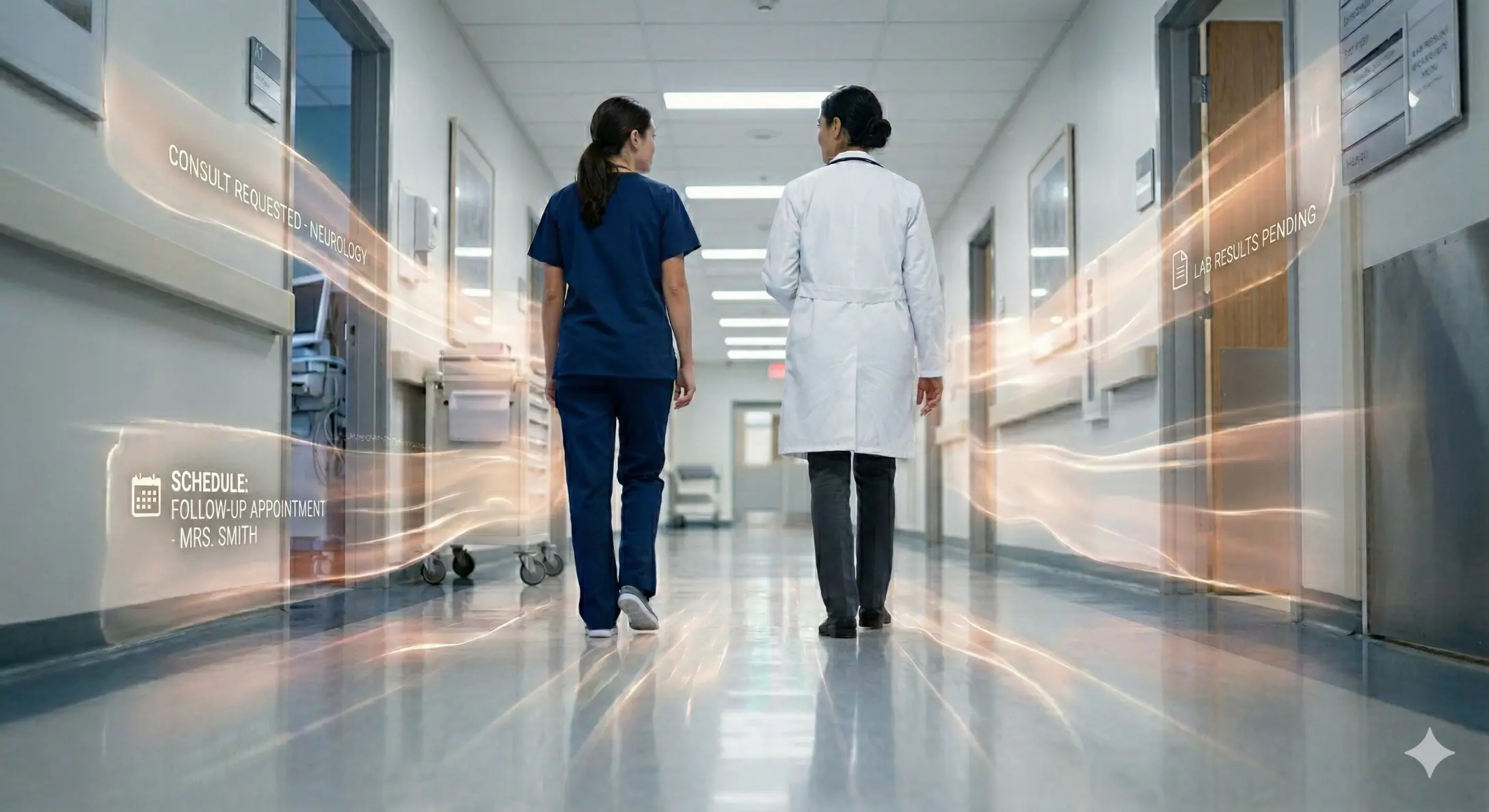
In complex specialty care, patients rarely belong to a single provider. Care delivery happens in teams: An oncology patient undergoing chemotherapy, for instance, might see their attending oncologist, an advanced practice provider managing symptom follow-up, and a medical assistant handling intake.
Yet most ambient AI documentation tools are built for a single provider documenting a single encounter. The physician presses the record button, the AI captures the visit, and the note gets generated. Pretty efficient for one clinician in a straightforward visit. But way off the mark for the collaborative reality of specialty care, where continuity across multiple team members directly affects patient outcomes.
Why does provider collaboration matter so much in specialty care?
When context is missing, the potential risks are high, and the gaps can compound quickly.
As an example, let’s continue with a chemotherapy patient. Their care journey typically involves handoffs between an oncologist and an APP who alternates visits, a nurse tracking side effects between appointments, and a care coordinator managing the details of scheduling and prior authorizations.
When documentation tools treat each encounter as a standalone event, the connective tissue gets lost.
Each team member holds a piece of the clinical picture. When documentation tools only treat each encounter as a standalone event belonging to one provider, the connective tissue across encounters gets lost. More often, providers recreate that connection manually by pulling up prior notes before the patient walks in.
A similar dynamic plays out in academic medical centers, where trainees may conduct initial evaluations that supervising physicians then finalize. In high-volume urgent care settings—where patient volume dictates fluid staffing—a patient might be seen by whoever's available.
Care teams function like this, and their tools must deliver within these workflows.
How does poor collaboration affect clinicians?
The workarounds to ensure provider collaboration are time-consuming and, in some cases, a genuine security risk. When a documentation platform only supports individual provider access, teams tend to improvise: shared logins, manual handoff notes, verbal updates are used, and details may not make it into the patient’s record.
Beyond security issues, the greatest issue is continuity. The clinician walking into an encounter without visibility into a colleague’s documentation the day before starts at a distinct disadvantage. They spend time recreating context from the EHR, ask the patient to repeat information already shared, or make do with an incomplete picture.
None of these outcomes serve patients well, and none reduce the documentation burden that ambient AI is supposed to address.
How should ambient AI support multi-provider care teams?
To begin, a well-designed ambient AI platform needs to acknowledge and respond to the fact that an encounter may not be a single-provider event. Multiple team members may touch a single patient visit, and that the notes generated from those interactions should be connected, not siloed.
A few capabilities matter most for provider collaboration:
Schedule sharing across the care team. When schedules get busy or no-shows arise, care teams can juggle appointments among themselves to maintain the day’s flow. If a clinician steps into a visit unexpectedly, they need access to what's scheduled and which provider owns what. Ambient AI that doesn’t satisfy this need operates in a closed, individual-provider context, creating friction at the moment when flexibility is required.
Multiple providers on a single encounter. In practice, an MA or resident often initiates the encounter: gathering history, documenting the chief complaint, running through the intake. The attending physician then completes it. What’s most important is that these aren't two separate encounters. They're one continuous patient interaction, and the documentation should reflect that.
Shared context from prior team member notes. The physician who walks into a room to finalize an encounter should have immediate visibility into what the MA or resident documented—without digging through the EHR, or asking the patient to repeat themselves. That shared context ensures that ambient AI supports care team workflows rather than individual provider convenience.
Role-based signing authority. Not every team member who contributes to documentation has the same authority to sign off on a note. MDs and APPs carry signing authority while MAs and residents generally do not. Treating these roles identically creates compliance risk. An ambient AI system that understands role-based workflows keeps the process clean.
How does DeepScribe approach provider collaboration?
DeepScribe built provider collaboration functionality around the realities of multi-provider specialty care. Schedule access is shared across the care team. Context from any team member's prior notes is available to the next provider who needs it.
When a physician has immediate access to the APP’s documentation, they are working with the full picture.
That context piece matters more than it might seem. Going back to oncology, continuity across rotating team members can mean the difference between catching a symptom early and missing it. (Care continuity is already complicated in oncology, and the potential for gaps is all too present.)
When an attending physician reviewing a chemo patient's status visit has immediate access to the APP’s documentation two weeks prior, they can see and are working with the full picture. When this visibility is missing, they’re only working with a fragment of care delivery.
Role-based routing is built in, so the documentation workflow reflects the actual clinical hierarchy. MAs and residents contribute to the encounter without holding signing authority. Without any manual rerouting, the clinical note reaches the right person on the care team for final review and sign-off.
With the above functionality in place, a care team doesn’t have to fit itself around a single-provider tool. Instead, their ambient AI follows the care team’s rhythms and workflows, ensuring continuity for patients.
Which specialties benefit most from provider collaboration in ambient AI?
Any specialty with multi-provider care patterns finds value in provider collaboration within their AI. However, the impact is most pronounced in situations where handoffs are frequent and the clinical stakes of missing context are highest.
In oncology, where APPs and MDs often team up on patient care delivery, and patients navigate complex, longitudinal treatment plans, shared context across the care team is a clinical necessity.
In orthopedics, academic environments in particular benefit from resident-to-attending documentation handoffs that don't require manual work to bridge the gap between what was captured and what needs to be finalized.
In urgent care, fluid staffing and variable walk-in volume mean clinician assignments aren't always fixed. An ambient platform that supports provider collaboration removes the problems of last-minute coverage changes.
Additionally, supporting this type of collaborative access is imperative in any health system settings structured around teaching and supervision. A fellow conducts a pre-procedure assessment which an attending then reviews—shared documentation context ensures both are working from the same record, not assembling separate pieces.
A must for complex, longitudinal care
Ambient AI has demonstrated value in reducing individual documentation burden and improving diagnosis capture. But specialty care, particularly the complex longitudinal care that defines oncology and academic medicine, requires more: a platform that understands how care teams actually work and supports their collective needs.
A patient with a chronic condition sees many clinicians over the course of treatment. Each visit should be considered one chapter in an ongoing clinical story. Documentation tools that treat each encounter as a standalone event, owned by one provider, don't serve that story. They fragment it.
As a technology built for care delivery, ambient AI is capable of doing better. For organizations with complex specialties, the ambient AI choice must meet care teams where they are and how they work. The alternative shortchanges the clinicians and, ultimately, their patients.
If you’d like to see how provider collaboration features can work for your healthcare organization, just let our team know.
text
Related Stories
Realize the full potential of Healthcare AI with DeepScribe
Explore how DeepScribe’s customizable ambient AI platform can help you save time, improve patient care, and maximize revenue.