Grit, Trust, and Ambient AI in Community Oncology: A Conversation with CEO Kathy Oubre
Pontchartrain Cancer Center CEO Kathy Oubre joins DeepScribe CEO Matthew Ko on Beyond the Chart to share how a combination of grit, community-focused care, and ambient AI is rebuilding both trust and presence in the exam room.



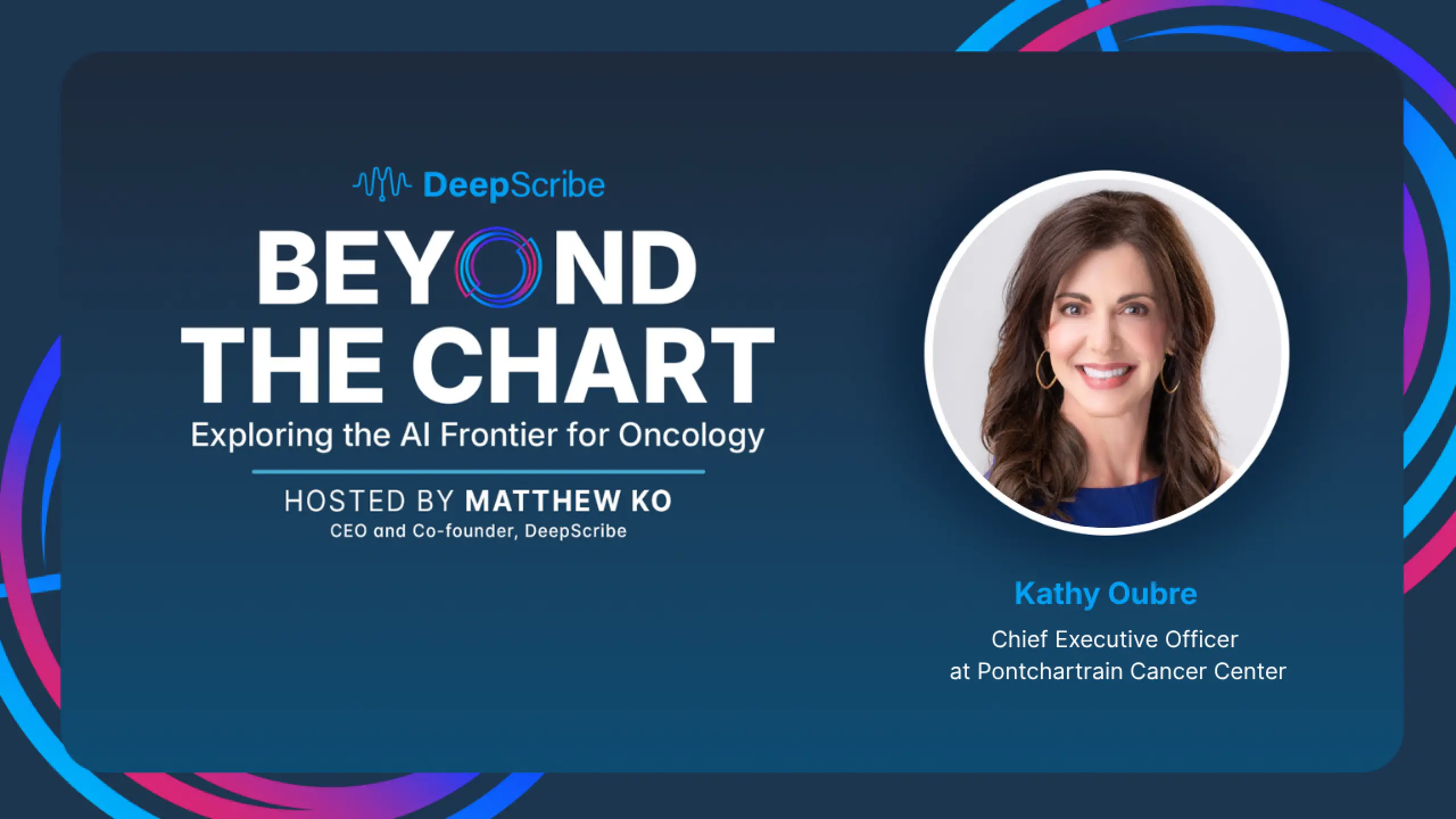
Guest
Kathy Oubre CEO, Pontchartrain Cancer Center; Board Member, Community Oncology Alliance
Key Insights
• Ambient AI addresses one of the most overlooked drivers of clinician satisfaction in oncology. It measurably improves the clinician–patient connection by allowing physicians to reclaim eye contact, presence, and trust during visits.
• Innovation in community oncology succeeds when culture is emphasized. Pontchartrain demonstrates how even smaller practices adopt advanced technologies effectively through a combination of grit, shared purpose, and cross-team alignment.
• The most actionable AI opportunities in oncology are those that reduce administrative burden, especially prior authorizations and downstream workflow demands. That’s where automation directly improves access, timeliness, and care continuity.
• Even as AI advances, oncology remains a profoundly human field. Technologies must reinforce the relational work that patients and clinicians value most.
Community oncology carries a unique combination of personal familiarity and business challenge. Practices provide an invaluable service by serving patients in the towns where they live, yet they must navigate increasing pressures—everything from staffing and retention challenges to administrative load.
But community oncology groups’ rapid adoption of ambient AI raises a central question: Can technology alleviate some of that pressure and make cancer care feel more human?
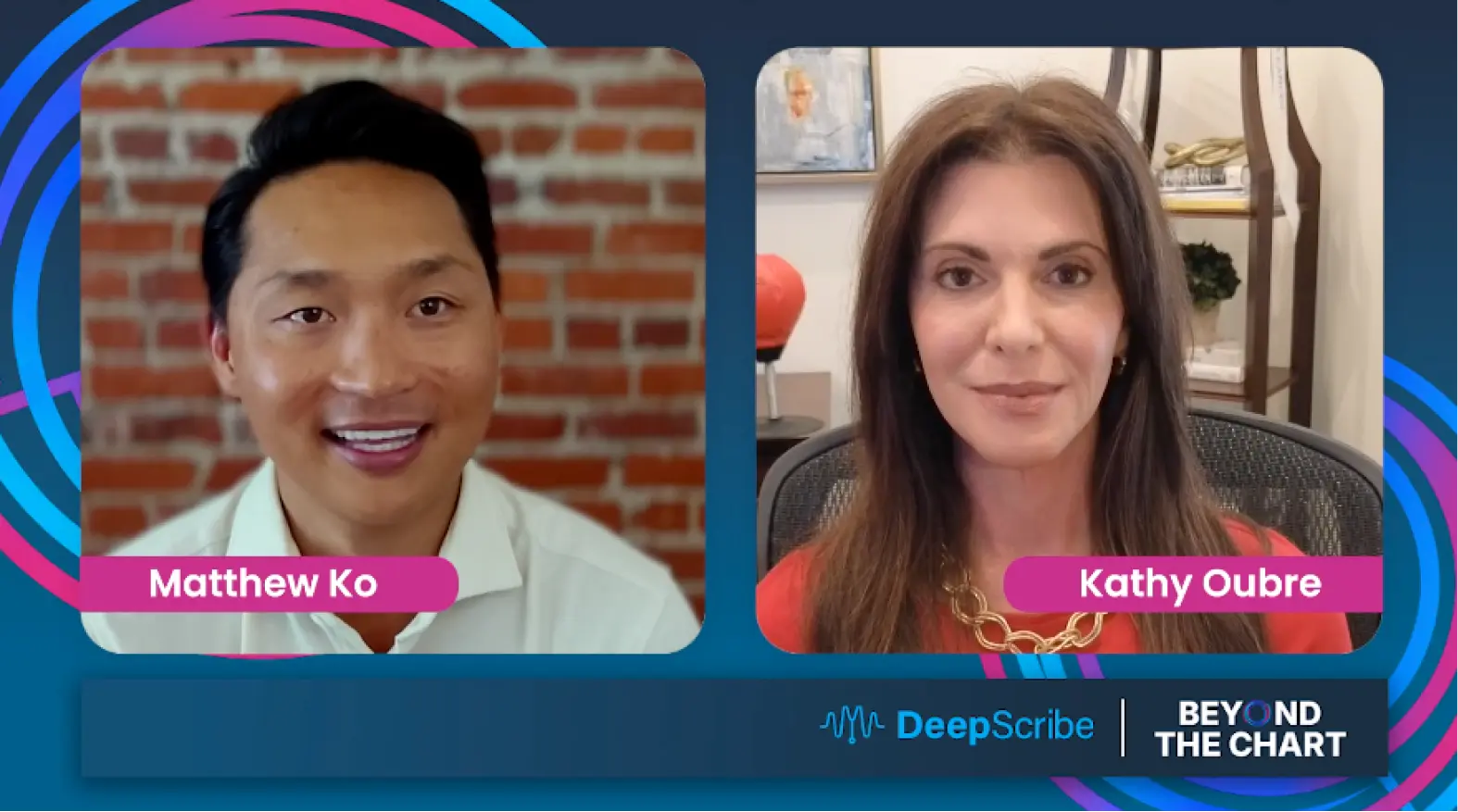
That’s a focal point in this episode of Beyond the Chart, as host Matthew Ko, DeepScribe founder and CEO, speaks with Kathy Oubre, CEO of Pontchartrain Cancer Center and a national voice in oncology policy. Their conversation reveals how Kathy guides a small Louisiana practice to preserve the clinician-patient relationship by bringing intangibles to thoughtful innovation—namely, grit and culture.
How Does Community Oncology Navigate Consolidation and Preserve Patient Access?
The Pontchartrain Cancer Center story is one of resilience shaped by geography and community bonds. In 2005, the practice reopened just days after Hurricane Katrina, and has since expanded to serve both suburban and rural regions. But the pressures of consolidation, shifting pharmacy networks, and eroding access are considerable. CEO Kathy Oubre sees the already underserved as suffering the most.
“A decade ago, patients in our more impoverished areas had more physicians and more pharmacies… over the last decade, we’ve seen movement out of those communities.”
Despite that context, Pontchartrain continues to anchor oncology care for the area, motivated by a rare closeness to the people it serves. For the practice, patients are more than individual conditions or diseases; they’re neighbors at the grocery store or families whose children grew up alongside the practice’s own.
How Does Ambient AI Rebuild Trust and Presence in Oncology Visits?
While many practices can be hesitant to adopt new technology, Kathy Oubre and the Pontchartrain Cancer Center team saw ambient AI as an opportunity to bring something fundamental back to the oncology visit: attention. She’s candid about seeing the EHR as having “damaged the physician–patient relationship with all the box-clicking.”
When Pontchartrain’s EMR partner approached them about piloting ambient documentation, the primary goal was restoration, even more than efficiency. The early impact was surprising, with patient visits growing longer, not shorter.
Those longer visits meant deeper conversation, more eye contact, and more trust.
“Ambient AI let our clinicians get back to why they went to medical school. Even though the visits were longer, the providers, the patients, and the family members were happier.”
For Pontchartrain, ambient technology wasn’t just a workflow tool. It was a relationship tool.
How Does Grit Foster Innovation in Community Oncology?
Pontchartrain Cancer Center’s innovation instincts came from a cultural throughline that Kathy Oubre names plainly: grit.
She recalls reading research about traits that are the best predictors of success, and laughing at how closely it mirrored her organization.
“The number one predictor of success is grit… and that’s one of the hallmarks of Pontchartrain.”
This ethos influences everything at Pontchartrain from hiring to decision-making. New initiatives aren’t handed down from leadership; they’re co-owned across the practice, a management imperative for smaller groups.
When it came to rolling out ambient AI to patients, that shared ownership made a major difference.
In the podcast conversation, Oubre recalls how nearly every patient consented to the use of ambient AI immediately. Clear communication and genuine enthusiasm from clinicians made it feel like something valuable, not just another technology.
Where Will AI Have the Greatest Clinical Impact in Oncology?
Looking ahead, Oubre imagines a world where AI sharpens precision and accelerates diagnosis: It elevates imaging, biomarker interpretation, pathology workflows, and precision medicine, all areas where complexity is far outpacing human bandwidth.
Thinking about use cases 10 years down the road, she envisions AI as a radiology tool that flags anomalies early, increasing detection rates and cutting down on false positives.
However, Oubre also has risk on her mind and cautions against overreliance on imperfect signals, especially in wearable tech and remote monitoring.
“The sky’s the limit with AI… but I think about balancing the excitement with an element of caution because I'm in charge of ensuring patient safety for all of those things.”
Oubre’s guiding principle is that innovation must reduce risk, not cover it up.
Which Oncology Workflows Benefit from AI Automation, and Which Require Human Connection?
Kathy Oubre is pragmatic about where AI can lighten the load. Some problems are ripe for automation, none more so than prior authorization.
“Prior authorizations are one of the most burdensome, maddening processes. I'm interested in lessening the burden—not replacing the people, but helping.”
For other areas, such as triage or virtual assistants, she draws a firm line in applying AI. Past experiments with automated phone systems failed immediately because patients wanted connection, not efficiency. Nurses echoed the same.
The way Oubre sees it, the technology must foster the relationship. “Then, we’re interested,” she says.
Like most community oncology groups, the Pontchartrain Cancer Center team sees human relationships as the clinical foundation of the organization.
Why Is Oncology Often Defined by Hope?
During the podcast, CEO Kathy Oubre addressed the common misconception that working in oncology is defined by sadness. For her, nothing could be further from the truth, and it's a narrative she corrects gently but firmly.
“It’s not a sad place to work… oncology centers are grounded and hopeful, and dedicated to providing care to their patients. It’s one of the best things I’ve ever done.”
Oubre sees oncology as a privilege, as patients allow clinicians to accompany them through the most vulnerable moments of their lives. The clinicians see the work’s meaning as profound, a sentiment that shapes the culture of the entire practice.
What Can Oncology Learn from Pontchartrain’s Approach to Innovation?
Kathy Oubre reminds us that innovation in oncology is not about adopting the newest tools. It’s about protecting and even reinvigorating the personal interactions in medicine. Her leadership shows both courage and restraint, with a willingness to test emerging technologies and a protectiveness that connection must remain at the center of care.
That theme was repeated throughout the episode: Technology must make room for humanity and even amplify it. At Pontchartrain Cancer Center, ambient AI has become a quiet partner in that mission, giving clinicians back the time, attention, and presence that define exceptional cancer care.
text
Related Stories
Realize the full potential of Healthcare AI with DeepScribe
Explore how DeepScribe’s customizable ambient AI platform can help you save time, improve patient care, and maximize revenue.