Restoring Humanity in Cancer Care: Burnout, Trust, and the Power of Ambient AI in Oncology with Dr. Diane Reidy-Lagunes
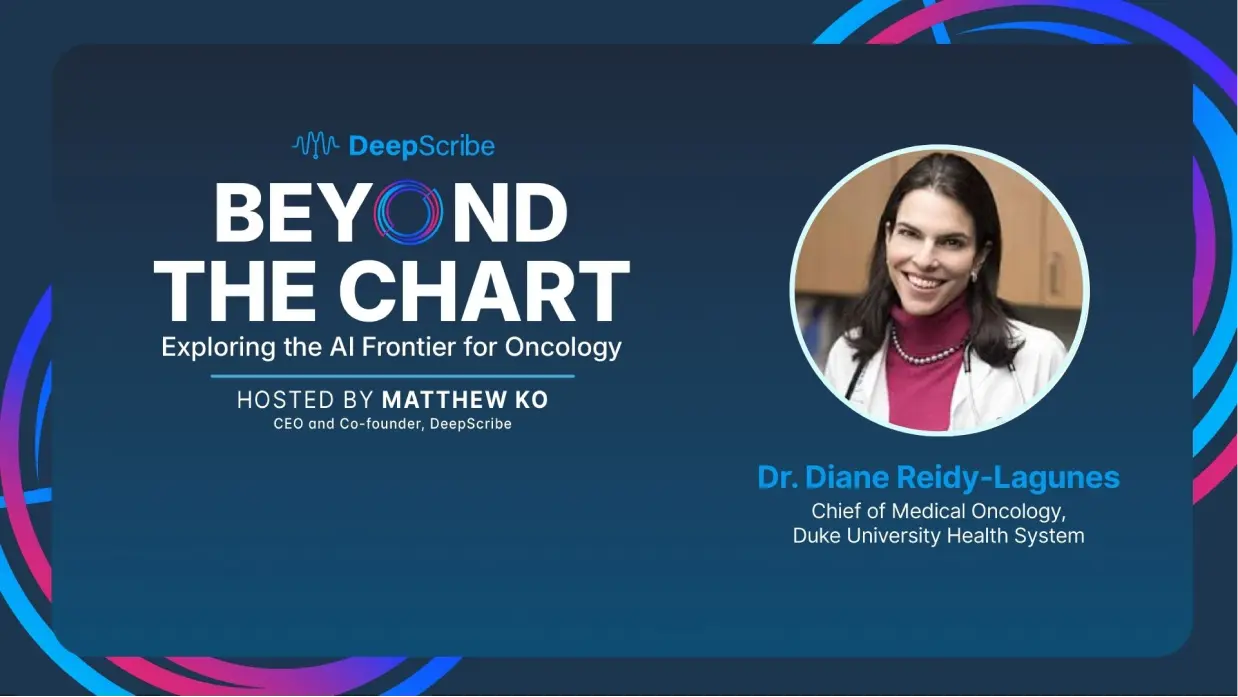
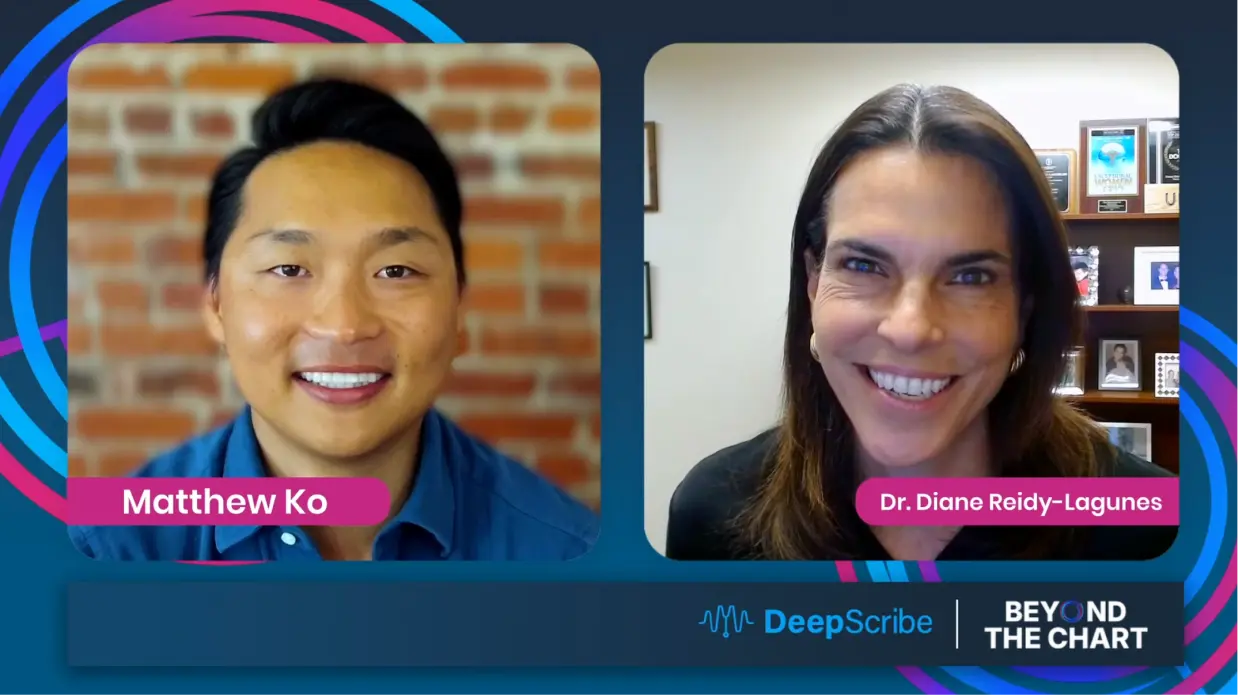
Duke oncology chief Dr. Diane Reidy-Lagunes joins DeepScribe CEO and founder Matthew Ko to explore what truly drives burnout in cancer care, and how ambient AI can restore presence, trust, and clarity at the bedside.



Guest
Dr. Diane Reidy-Lagunes, MD
Chief of Medical Oncology and Associate Vice President of Oncology Services, Duke University Health System; former Associate Deputy Physician-in-Chief, Memorial Sloan Kettering Cancer Center
Key Insights
- Burnout in oncology is driven less by workload and more by losing presence with patients due to documentation burdens.
- Ambient AI can act as both a compassion tool and a retention strategy by reducing administrative load and restoring face-to-face communication.
- Oncology will adopt AI more successfully when tools are simple, trustworthy, and built specifically for the emotional and operational complexity of cancer care.
- AI’s future in oncology extends far beyond notes: clinical trial matching, radiology, dermatology, and precision response prediction are already transforming care.
Why Does Human Connection Matter So Deeply in Oncology?
For Dr. Diane Reidy-Lagunes, oncology is “a marriage between science and compassion.” A cancer diagnosis is often “the most terrifying moment” in a patient’s life, demanding more than just clinical mastery. It’s a moment that also requires emotional fluency.
“You have to understand the language of science but you also have to recognize the human aspect of where the patient is.”
Patients rarely recall every detail of medical information, but they remember how a doctor made them feel. It’s a sacred connection that plays a vital role in a cancer patient’s comfort and understanding of the situation. Yet that connection is often strained or challenged as clinicians must split their attention between patients and screens.
This disconnect sets the stage for understanding burnout differently.
What Is the Real Source of Physician Burnout Today?
Most people assume burnout is about volume. Too much, all day long. But Dr. Reidy-Lagunes draws a different line: Burnout is caused by the loss of time with patients.
“Burnout is not seeing 40 patients in a day. Burnout is not being able to see the patient because I’m chained to a computer.”
Documentation requirements, billing workflows, and EHR rigidity turn clinicians into the role of clerical operators. Dr. Reidy-Lagunes recalls her disappointment the moment her institution fully adopted digital documentation, knowing it could pull focus away from a patient at the exact time that they needed it.
“I refuse to look at a computer screen when I’m supposed to be talking to a patient about life-changing news.”
For Dr. Reidy-Lagunes, burnout is the erosion of the very meaning clinicians find in their work.
Ambient AI offers a way to stop that breakdown and restore meaning.
How Is Ambient AI Changing Clinician Experience and Retention?
At both Memorial Sloan Kettering and Duke, Dr. Reidy-Lagunes has watched ambient AI shift morale, culture, and efficiency. When the technology automatically generates the clinical note, providers regain the ability to be fully present with patients, looking at them directly and hearing the nuance in their voice.
“We can bring compassion back to the bedside—literally and figuratively.”
For her, the power of ambient AI is as a retention strategy. Physician turnover is expensive and destabilizing. What keeps oncologists wanting to deliver care right where they are? Culture is the differentiator, especially as the field faces a continually rising workload and shrinking margins.
Ambient AI has become part of a culture in which clinicians can reconnect with the parts of the job that make them want to stay.
What Can AI Do Beyond Documentation in Oncology?
It’s become a common part of conversations about ambient AI in oncology: The potential and use cases extend far beyond charting. Dr. Reidy-Lagunes outlines a future already beginning to materialize across cancer programs:
- Clinical trial matching: AI can identify eligibility in seconds by scanning genomic and clinical data.
- Radiology and dermatology: Models trained on vast image datasets now outperform humans in identifying benign lesions.
- Treatment monitoring: Instead of waiting 8–10 weeks, AI may reveal response patterns within one to two weeks.
- Precision care: Integrating genomics, imaging, conversation-level data, and clinical histories could deliver more personalized treatment pathways.
AI won’t replace clinicians she notes, but it will remove barriers that prevent them from doing their best work. “If machine-based learning can improve aspects of care, why wouldn’t we use it?”
Why Are Social Determinants the Missing Piece in Oncology Notes?
Cancer visits often revolve around high-stakes medical decisions. But the elements that determine whether patients can follow through—social determinants of health or SDOH—frequently go undiscussed and undocumented. That can include access to transportation, caregiving responsibilities, ability to afford medication, and even job security.
“Guilty as charged,” admits Dr. Reidy-Lagunes. I don’t ask enough. We always say we want to take care of the patient, not the disease.”
Regardless of the reasons behind SDOH being overlooked during care, ambient AI changes the dynamic by capturing every word, including subtle cues clinicians may miss. This richer context becomes a new source of clinical intelligence, highlighting blind spots and presenting the full story of the patient. (See data on how DeepScribe has improved capture of SDOH in oncology.)
How Do You Build Trust in AI Tools Among Oncologists?
Adoption of AI hinges on two characteristics: simplicity and relevance. It should be clearly understood that the workflows, data requirements, and even emotional rhythms of oncology are different from those of other specialties. Technology that fails to acknowledge these differences risks rejection.
Dr. Reidy-Lagunes puts it simply: “The easier it is to use, the more welcome it will be.”
She also considers additional ambient AI uses being critical to helping clinicians get through their day. For instance, due to federal mandates, patients can see results and radiology reports immediately, written in “medical jargon” and often without explanation. That can create confusion or fear—and a frantic series of phone calls to the doctor.
“I have patients who are absolutely terrified because they read their radiology scan and saw something that turned out to be benign. Could you envision AI to say ‘here’s the translated version of what this means?’”
AI could be applied to translate medical jargon into patient-friendly language, reducing the emotional friction patients experience in that information gap between testing and interpretation.
What Do Technologists Need to Understand About Oncology?
As with every episode of Beyond the Chart, Matthew Ko posed this question to Dr. Reidy-Lagunes. Her answer was simple and urgent.
“Keep going.”
She sees enormous potential in using AI to elevate the most delicate moments in oncology: clinical trial conversations, prognosis discussions, transitions of care, end-of-life planning. Dr. Reidy-Lagunes imagines AI-generated summaries that help patients and families revisit conversations with clarity and support.
The goal is not more data. It’s more meaning.
What Kind of Future Do Oncology Clinicians Want?
For Dr. Reidy-Lagunes, ambient AI won’t be the hero of the care delivery story, but it’s making it possible for clinicians to be. The grounding truth is that oncology is, and must remain, human.
As oncology crosses this inflection point, the question is no longer whether AI will be adopted widely or transform daily workflows. The question is how we all ensure that the transformation strengthens connection, precision, and humanity.
text
Related Stories
Realize the full potential of Healthcare AI with DeepScribe
Explore how DeepScribe’s customizable ambient AI platform can help you save time, improve patient care, and maximize revenue.