Tennessee Cancer Specialists: Returning the Patient Visit to the Patient with DeepScribe
At this 16-location community oncology organization, even the most discerning clinicians have adopted DeepScribe ambient AI - and their patients notice a difference.



Dr. Kanishka Chakraborty will tell you that, for years, he wasn’t fully in the room with his patients. He'd be listening to them, but he was already contemplating the note he'd have to draft later.
"I had to think in my head what your complaints are, what I'm sharing with you, and that I want to put the similar things in my note," he says. That distraction was there in the room with every visit.
Then, ambient AI became part of the moment of care for the medical oncologist-hematologist and his Tennessee Cancer Specialists colleagues. The difference was distinct enough for patients to notice.
“A few of my patients said ‘You look much more happy. What's going on?’," Dr. Chakraborty recalls with a laugh. Adding DeepScribe to care delivery specifically removed that long-present exercise to remember what was being said. "DeepScribe has brought me the ability to be there and talk to my patient without any impatience," Dr. Chakraborty says.
A Practice Built for Close-to-Home Care
Formed in 2004, Tennessee Cancer Specialists is the largest independent, community oncology practice in eastern Tennessee: Sixty-five clinicians treat local patients across 16 locations that stretch from the Virginia line down through the state's southeastern counties, helping patients avoid long drives for cancer care.
Treating patients close to their home is one of the most important facets of care for community oncology centers. In fact, Dr. Chakraborty left an academic oncology program after 14 years because he wanted to help deliver advanced care to patients in East Tennessee without them having to travel for it.
“Cancer is such a hard word, and we’re seeing some of these patients at their hardest times.” – Stacie Rose, RN, Clinical Educator
The ability to connect with patients is another hallmark of TCS, as nurse practitioner Joshua Buck will tell you. “My personal approach to care? I want you to like me." For Josh, having that rapport with patients—and with DeepScribe, the ability to concentrate on their words, mood, and body language—tells Josh what’s truly going on with each patient.
Clinical educator Stacie Rose, an RN and part of the practice's leadership team, also sees that focus as a defining trait of TCS. "Cancer is such a hard word, and we're seeing some of these patients at their hardest times." A good day, she says, is when her clinical team can give patients uninterrupted attention and still leave the building without a stack of unfinished notes waiting for them.
From AI Skeptic to AI Satisfied
Throughout their careers, every oncologist regularly has some unfinished documentation or administrative work to tackle after a full day in clinic. That was the case at TCS before DeepScribe. Josh Buck was bringing charts home most nights, jokingly telling his wife he had "homework."
At one point, Stacie Rose was staring at a documentation backlog so constant it required chasing providers down.
“I’d say ‘Hey, we're waiting on that note for billing purposes. We’re waiting on that note for prior auth purposes’,” she recalls. “With DeepScribe, we cut that down significantly.”
“I tell [former colleagues] about DeepScribe and they say ‘that sounds incredible.’ I don’t rub it in too much.” — Joshua Buck, NP
Not everyone was eager to hand the documentation process to ambient AI. Dr. Chakraborty was one of the pickier evaluators.
“My main concern was how compatible it would be with oncology,” he explains. "Our discussion is a little bit complex and we’re addressing something that’s emotional. I do not want that to be deflated or inflated by AI."
Having AI built specifically for oncology—not adapted after the fact—was a distinction that mattered across the practice, and an aspect of DeepScribe that still surprises Stacie Rose.
"It's kind of amazing that it can take all of that relevant data, all of that oncology-specific terminology, all those crazy drug names, and put it into the note, and it's correct," she says.
Josh Buck shared his satisfaction with former colleagues who came away unimpressed from their experiences with other ambient AI vendors. It’s become a point of playful jealousy. “I tell them about DeepScribe and they say ‘that sounds incredible’,” he says. “I don’t rub it in too much.”
Ambient Intelligence Built Into the Full Clinical Workflow
The DeepScribe team worked with TCS on-site, meeting with clinicians to customize each provider’s documentation preferences, a method DeepScribe has found to be a leading driver of ambient AI adoption.
Once the clinicians saw the note output, any skepticism was pushed aside.
Stacie Rose laughs about her team’s immediate responses to seeing what DeepScribe could do documenting their encounters. "I heard a lot of ‘Oh my gosh, I sound so much smarter’," she recalls, “and ‘Wow, I'm already done with my note.’”
Dr. Chakraborty, who has hematology cases with dense terminology, was struck by how well DeepScribe captured his assessment and plan, going beyond the basic subjective complaint to the layered clinical reasoning that oncologists rely on. Josh Buck simply called the note quality “phenomenal.”
The same ambient intelligence that generates precise notes doesn't wait for the visit to start. Buck had previously been in the building at least 30 minutes before his 8 a.m. start to work through each patient's labs, treatment history, imaging, and outside records before his first appointment.
DeepScribe has now built that groundwork directly into the same system with SmartPrep, the pre-visit intelligence layer of DeepScribe's Ambient Operating System for oncology.
“Before, I opened the old note to review,” says Dr. Chakraborty. “Now, SmartPrep tells me what to address with the patient or indirectly reminds me if I have forgotten to review a study."
“SmartPrep keeps me from digging into the chart," Joshua Buck says. "It's a nice addition, makes my pre-charting easier, for sure."
An early group at TCS started using SmartPrep in late June—including Josh and Dr. Chakraborty—and quickly reached 100% adoption.
Restoring Conversation and Compassion
Beyond note-taking, TCS clinicians point out what ambient AI is affording them in the exam room: Setting the laptop aside and having a back-and-forth conversation unencumbered by data entry needs. Being attentive to concerns and questions. Developing the warmth and connection that only comes from personal conversation.
“I’m talking about their personal life. When their grandkids are coming, what cruise trip they are going on. You cannot build that bond if you are stuck only taking care of the disease.” – Kanishka Chakraborty, MD, medical oncologist-hematologist
”Once our oncology- or hematology-related discussion is over, I'm talking about their personal life,” says Dr. Chakraborty. “When their grandkids are coming, what they are doing 4th of July, what cruise trip they are going on.” For Dr. Chakraborty, lingering past the clinical conversation is what builds real trust. “You cannot build that bond if you are stuck only taking care of the disease.”
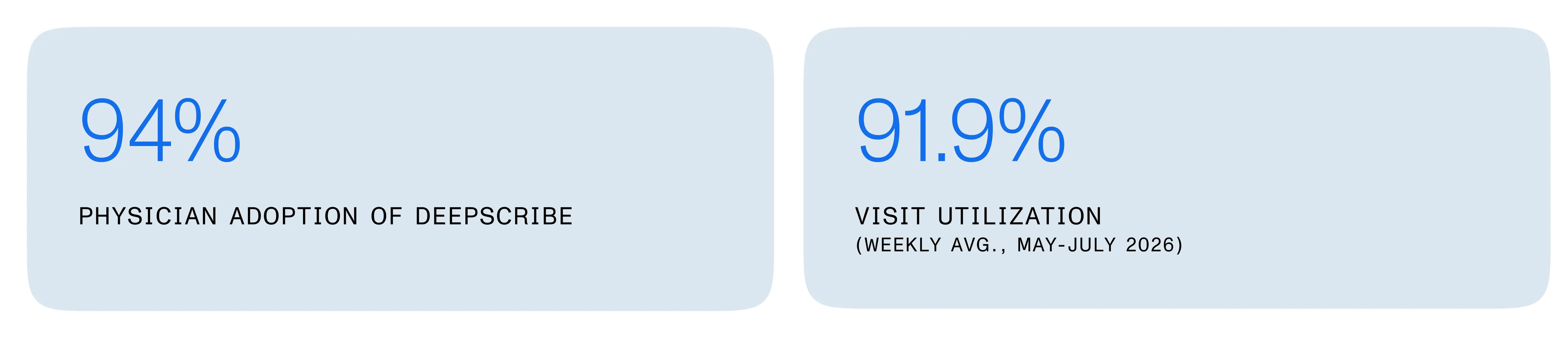
The numbers at Tennessee Cancer Specialists reflect how thoroughly the shift to ambient AI has taken hold. Adoption across their entire team of 65 clinicians has been at 94%, and regular DeepScribe usage has continually climbed since the full rollout was complete in October 2025: The number of TCS patient encounters captured by DeepScribe has increased 33% in just the first half of 2026. Currently, TCS clinicians are using DeepScribe for 92% of patient visits each week.
Widespread enthusiasm at TCS
Stacie Rose has watched some of her team’s early hesitation dissolve into something close to unanimous enthusiasm. "Even docs that were a little iffy saw their colleagues doing it and wanted to try it too. Everyone seems to enjoy it, and they're just using it."
One key to smooth change management? A smooth rollout.
"I think everyone was a little bit surprised at how well the implementation went,” she says. “We didn't have any problems at all."
That kind of organic buy-in is best illustrated by the experiences of individual clinicians. Dr. Chakraborty, once a skeptical AI evaluator, has become an advocate. Part of what won him over is the precision with which DeepScribe handles oncology.
"Oncologists like myself are kind of OCD," he says. "We want to convey our messages in certain ways that could be prominent, that someone can just glance through and catch. It was a little surprising how DeepScribe is able to do that."
"I have actually counseled and persuaded many of my colleagues to adopt," Dr. Chakraborty says. "And now they say, 'I'm glad I'm doing it.'”
For a practice built around keeping advanced cancer care close to home across East Tennessee, adding an ambient AI tool made for oncology has done more than cleared the backlog of notes. It's given clinicians more of themselves to bring into every visit. As TCS continues growing, that's the foundation they're building on.
You may also like:
Texas Oncology uses DeepScribe AI to stop clinician burnout, connect with patients, and automate coding
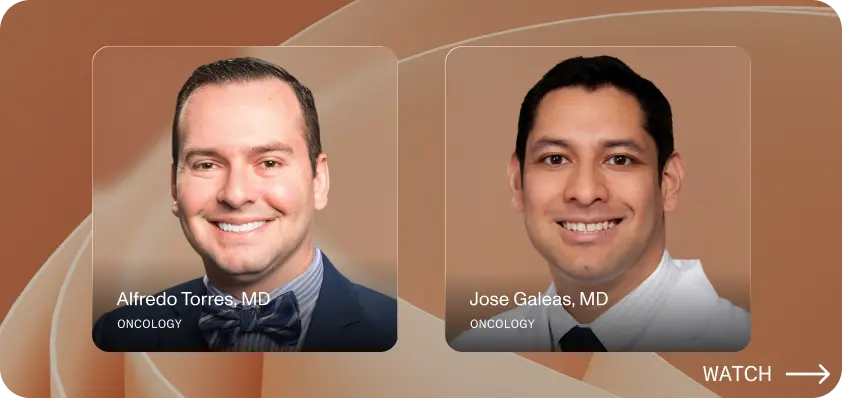
Dr. Jose Galeas on the value of being present with patients
text
Related Stories
Realize the full potential of Healthcare AI with DeepScribe
Explore how DeepScribe’s customizable ambient AI platform can help you save time, improve patient care, and maximize revenue.