The Patient Experience in Oncology: What 9 Cancer Care Leaders Are Saying
In a special edition of the Beyond the Chart podcast, we compiled thoughts and stories from oncology leaders about the cancer patient experience. The result is a narrative that includes the technical, the personal, and an opportunity for technology to help create a better experience.



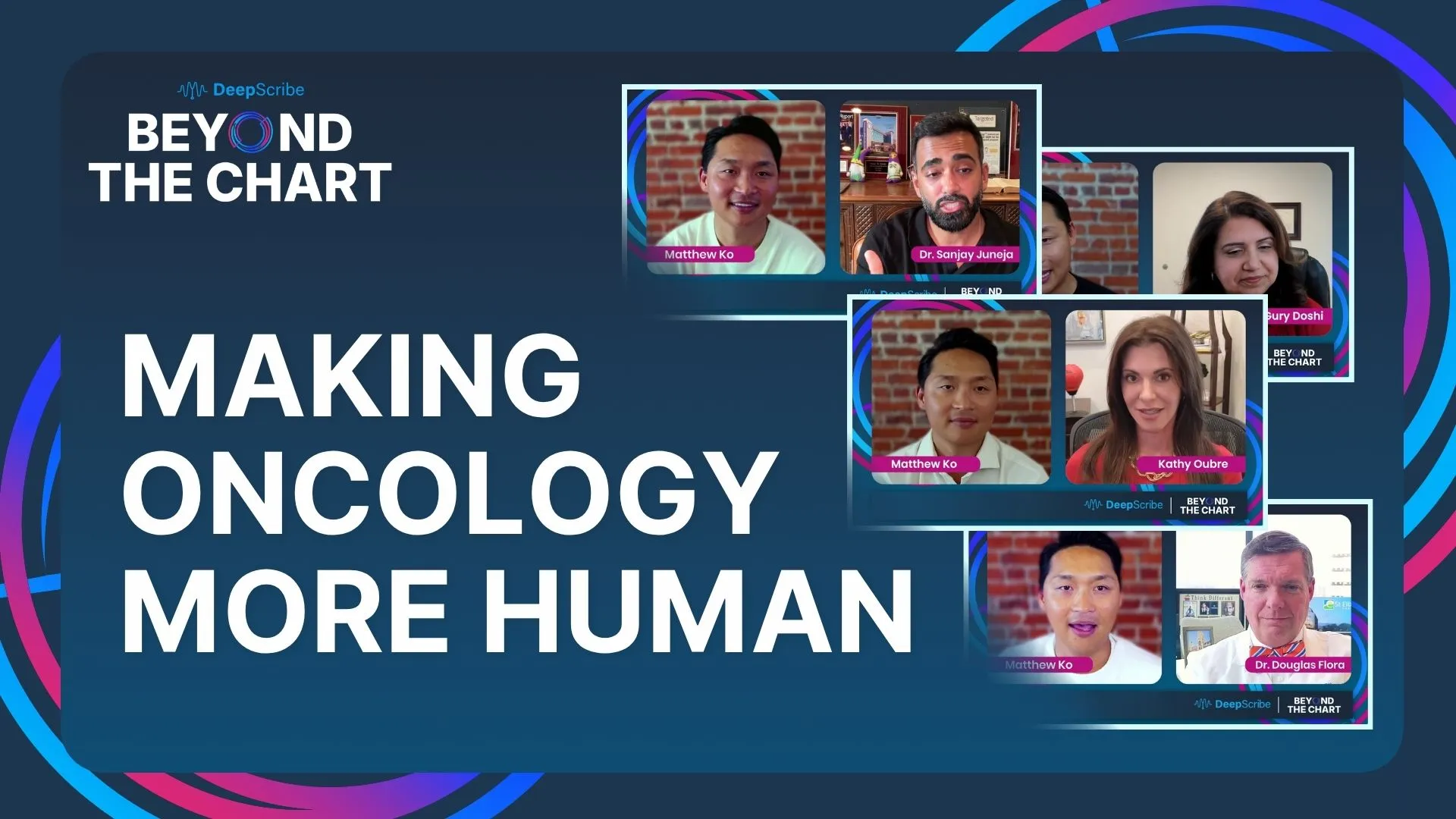
In its first year, the oncology podcast Beyond the Chart: Exploring the AI Frontier for Oncology has become a place for cancer care leaders to talk about their commitment to patients, and solving so many of the problems in oncology.
With show host Matthew Ko, DeepScribe CEO and founder, they’ve shared what it takes to deliver cancer care today, what the broader oncology ecosystem looks like, and what role AI should (and must) play for clinicians and patients.
For a special edition of the podcast, we’ve compiled highlights from nine of those conversations, with a specific focus on the patient experience.
Each voice comes from a different vantage point: practicing oncologist, medical director, cancer center CEO, survivorship specialist, AI leader. Yet, common ideas about oncology surface:
- Oncology is different from other areas of medicine.
- The whole patient matters more than just the diagnosis on the chart.
- AI’s responsibility is to preserve the human connection at the center of care.
You can watch the full highlight episode above, or scroll ahead to see individual clips from these oncology leaders.
>> How Is Oncology Different From Other Specialties?
For the clinicians who treat cancer, the stakes are both constant and personal. Beyond the Chart guests describe what that means to them and their organizations.
Kathy Oubre, CEO, Pontchartrain Cancer Center
Kathy on treating patients who are also her neighbors, and how that connection affects her community cancer center.
Dr. Diane Reidy-Lagunes, Chief of Medical Oncology, Duke University
Dr. Reidy-Lagunes on the weight of sharing a cancer diagnosis, and the responsibility that comes with sitting across from a patient in that moment.
>> What Does It Mean to Treat the Whole Patient in Oncology?
There are significant parts of a patient's life that don’t show up on a chart; yet, they can shape almost every decision a clinician makes.
Dr. Gury Doshi, Medical Director, Texas Oncology; Chair, Pharmacy & Therapeutics Committee, USON
Dr. Doshi on why a patient's social history—who's caring for their kids, what their week looks like—matters as much as their pathology report.
Dr. Douglas Flora, Executive Medical Director, Yung Family Cancer Center; Editor in Chief, AI in Precision Oncology; author, cancer survivor
Dr. Flora on the details of a patient’s life that never make it into the progress note and why those details can drive a treatment decision anyway.
Dr. Lalan Wilfong, Chief Medical Officer, Navista
Dr. Wilfong on tracking what happens to a patient after they leave the exam room, and catching the problems the patient doesn’t mention themselves.
>> What AI Can’t Replace in the Patient-Clinician Relationship
Four of our guests, across four different conversations, land on the same idea: the job of technology is to protect the connection between doctor and patient, not get in its way.
Dr. Sean Khozin, CEO, CEO Roundtable on Cancer
Dr. Khozin on how ambient AI can help physicians rebuild the relationship that the documentation burden has eroded over the past two decades.
Kathy Oubre, CEO, Pontchartrain Cancer Center
Kathy on how things changed at PCC once providers could spend more time facing their patients rather than a screen.
Dr. Diane Reidy-Lagunes, Chief of Medical Oncology, Duke University
Dr. Reidy-Lagunes on burnout—and why it was never defined by seeing too many patients in a day.
Dr. Debra Patt, EVP, Texas Oncology; President, Community Oncology Alliance
Dr. Patt on wanting patients to see her face—not the back of her head—and how that presence affects how her patients experience care.
>> How Should AI Support Clinical Decisions in the Moment of Care?
Four guests describe what AI support should look like at the point of care, and they all agree: AI isn’t a replacement for clinical judgment, but more like a second set of eyes that don’t get tired.
Dr. Sean Khozin, CEO, CEO Roundtable on Cancer
Dr. Khozin on the signals in how a patient speaks, and what those signals convey that words alone don't capture.
Dr. Debra Patt, EVP, Texas Oncology; President, Community Oncology Alliance
Dr. Patt on changing the care plan for one patient after using a clinical AI tool mid-visit to work through a rare diagnostic question.
Dr. Douglas Flora, Executive Medical Director, Yung Family Cancer Center; Editor in Chief, AI in Precision Oncology; author, cancer survivor
Dr. Flora on a proposed AI use case: using pattern recognition to flag a slow decline in a routine blood marker, pre-emptively understanding potential cancer years earlier than a clinician would on their own.
Dr. Sanjay Juneja, oncologist; VP, AI & Medical Informatics, Tempus AI; co-founder, Tensor Black; The OncDoc
Dr. Juneja on how ambient intelligence could learn the operational bottlenecks that cost patients time and even jeopardize care.
>> How Can AI Help Patients Directly?
The conversation about AI in oncology usually centers on clinicians. These two guests make the case for patients as direct beneficiaries too.
Dr. Debra Patt, EVP, Texas Oncology; President, Community Oncology Alliance
Dr. Patt on why one-size-fits-all patient education handouts fail, and what a more personalized version via AI could look like.
Dr. Lidia Schapira, Director of Cancer Survivorship, Stanford Health Care
Dr. Schapira on preparing patients to navigate a fragmented healthcare system and advocate for themselves, long after treatment ends.
The Common Thread in Cancer Care Conversations
Patients know when they’re truly being seen and listened to, and when they’re not. That’s a shared sentiment across these nine guests and conversations, and it’s a reality that can make patients either feel cared for, or disconnected and confused.
For the clinician not using AI during patient visits, deciding to devote their full attention to the patient can lead to charting during evening hours, with important clinical details left to memory. Beyond the Chart conversations like these reinforce that shouldn’t have to be. The technology is there to offer administrative work relief, clear the way for the connection between clinician and patient, and serve up information so care and that relationship can flourish.
To watch the full podcast episode for any of these guests, just click or tap their name below:
Dr. Gury Doshi, Medical Director, Texas Oncology; Chair, Pharmacy & Therapeutics Committee, USON
Dr. Douglas Flora, Executive Medical Director, Yung Family Cancer Center; Editor in Chief, AI in Precision Oncology; author, cancer survivor
Dr. Sanjay Juneja, oncologist; VP, AI & Medical Informatics, Tempus AI; co-founder, Tensor Black; creator of The OncDoc
Dr. Sean Khozin, CEO, CEO Roundtable on Cancer
Kathy Oubre, CEO, Pontchartrain Cancer Center
Dr. Debra Patt, EVP, Texas Oncology; President, Community Oncology Alliance
Dr. Diane Reidy-Lagunes, Chief of Medical Oncology, Duke University Health System
Dr. Lidia Schapira, Director of Cancer Survivorship, Stanford Health Care
Dr. Lalan Wilfong, Chief Medical Officer, Navista
text
Related Stories
Realize the full potential of Healthcare AI with DeepScribe
Explore how DeepScribe’s customizable ambient AI platform can help you save time, improve patient care, and maximize revenue.