How Do You Build Technology That Oncologists Actually Trust? Two Tech Founders Talk
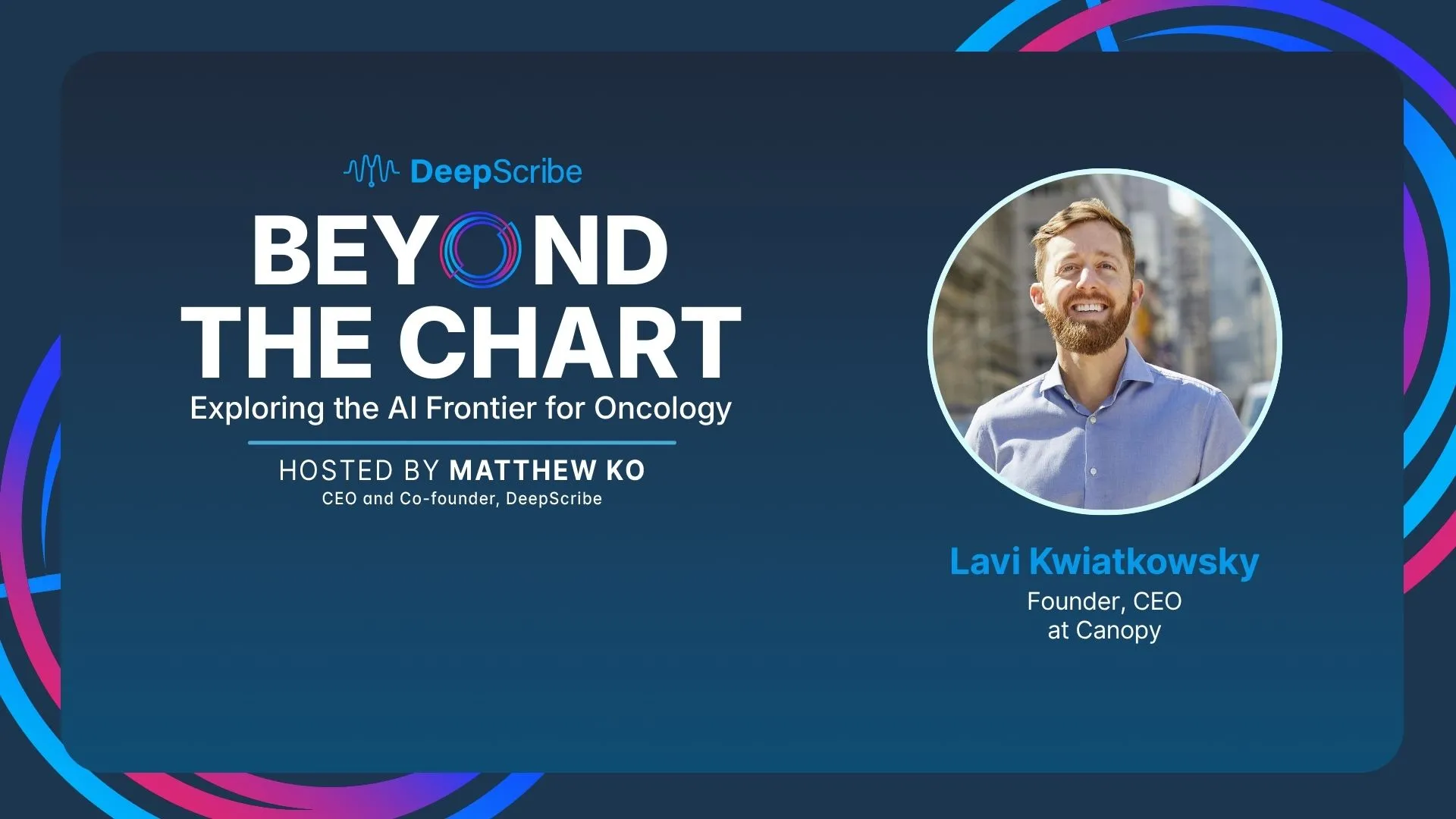
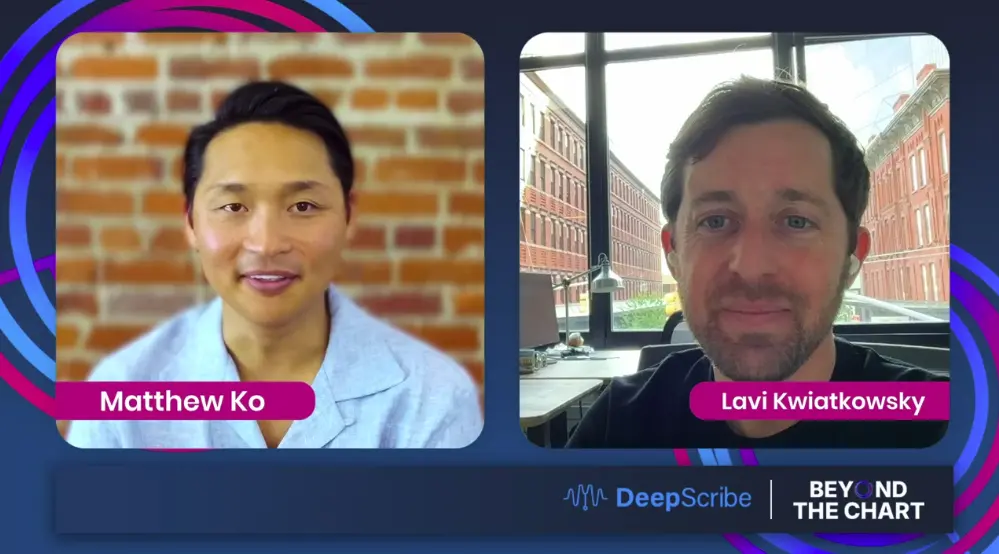
DeepScribe CEO and founder Matthew Ko talks with Canopy founder and CEO Lavi Kwiatkowsky about why oncology practices adopt new technology slowly, and what it takes to earn a clinician's trust at the point of care—and after.



Beyond the Chart Podcast Guest
Lavi Kwiatkowsky, founder and CEO of Canopy
Canopy is a platform built for the care that happens between oncology visits and across patient services. It enables practices to identify and prioritize patients who need help, resolve their issues using AI-native tools, and generate new reimbursement streams. Canopy is a partner to more than 2,000 oncology providers across 500-plus sites of care.
Key Insights
- Software rarely gets the built-in trust that a new drug gets. A drug arrives with a decade of clinical trials, FDA approval, and reimbursement infrastructure already in place. Software has to earn that trust gradually, through demonstrated results and physicians recommending it to peers.
- Technology must bend to the clinician's workflow, not the other way around. Both founders believe that clinical staff should not be asked to adapt to a rigid system. They described mapping a practice's exact workflow, screen by screen, before introducing any new tool.
- Point solution fatigue is pushing practices toward consolidated platforms. As oncology staff juggle more standalone systems, both leaders see momentum shifting toward consolidation: integrated tools that reduce the number of logins and screens a single workflow requires.
- Catching symptoms between oncology visits keeps patients on treatment longer. Canopy's published data shows that when patients have a direct channel to report problems before they become emergencies that there is improved treatment persistence and meaningful reductions in hospitalizations.
Why is oncology slow to adopt new technology?
Lavi Kwiatkowsky opened the conversation with a comparison: a new drug and a new piece of software start from very different positions of trust. A drug arrives already validated by a clinical trial and FDA approval, with reimbursement and distribution mechanics largely solved before a physician ever writes the prescription.
Software has no equivalent built-in infrastructure. It has to earn trust more gradually, through demonstrated results and physicians vouching for it to their peers, rather than a formal process that clears it for use all at once.
Lavi believes that gap matters more in oncology than almost anywhere else in medicine, because the stakes attached to any change are so high. Oncologists are trained to be careful, and a tool that works beautifully in a controlled study can still fail if the underlying software isn't built well or wasn't implemented with the same rigor.
“Not all technology is made the same, and even the same technology improves throughout time.”
Matthew Ko draws a parallel to DeepScribe's own history, noting that ambient documentation didn't immediately take off. It took years of iteration before the quality reached a point where practices described it as a genuine shift in how they worked, rather than just another tool competing for attention.
What does it actually take to build trust in healthcare technology?
For Lavi, trust starts with a product’s implementation, not the product itself. The Canopy team goes on-site to map a practice's existing workflow in detail, tracking exactly which system a staff member touches at each step. Only then, will they design for a workflow. He described watching staff manage multiple screens and queues across different systems, and noted that the fix isn't always fewer systems. Sometimes three well-designed systems beat two that are poorly integrated.
Matt connected this back to a principle he applies at DeepScribe: Technology should adapt to how a clinician already works, not demand that the clinician change their behavior to accommodate the software. Lavi argued that no amount of implementation rigor on its own matters if the practice doesn’t buy in from the start.
"You have to start with a willing partner. If the partner's not willing, you're not gonna change anything."
Both founders agreed that new products rarely work well in their first few months in the field. Canopy expects to revise a new feature repeatedly once it meets the reality of daily clinical practice; Matt described the same pattern at DeepScribe, where feedback from one practice can surface dozens of adjustments before a feature is ready for the next group.
How does remote patient monitoring change care between visits?
There’s an imbalance in oncology that Lavi points out as fundamental. Patients spend the overwhelming majority of their treatment time outside the clinic, yet most care-related technology is designed for the moment when the patient is in the room with their care team. It’s a gap that Canopy's core product addresses. Their remote monitoring lets patients report symptoms as they happen, so members of the clinical team can intervene before a manageable issue becomes a hospitalization.
Lavi shares that the results have been substantial enough to reshape how some practices think about the return on a monitoring program. Canopy has published research showing hospitalization reductions tied to earlier detection of treatment-related complications, alongside improvements in how long patients stay on therapy.
The conversation also touched on why follow-up calls to patients have not always happened. Follow-up calls after a first treatment cycle only became part of oncology quality standards after the medical community acknowledged how dangerous systemic therapy could be.
But there’s a distinction between a follow-up call and remote patient monitoring. That follow-up call captures only a moment in time; a monitoring relationship that runs the full length of treatment—sometimes a year or more—gives patients a consistent way to reach their care team exactly when they need it.
What turns a skeptical clinician into a technology champion?
There’s a pattern that both founders identify: physicians who resist a new tool the most are often the strongest advocates once they see it work firsthand.
Matt describes a physician who insisted for months he would never use an ambient scribe, having built his own reputation on fast, accurate manual documentation. The day he finally tried an AI scribe, he texted to say he couldn't believe he had waited so long. For Matt, that moment is the one of the most rewarding parts of the work.
"Your detractors turn into supporters. When you have those people, that's your best-ever marketing."
Lavi draws a comparison to the reception for self-driving cars, noting that Waymo's safety data didn't initially convince skeptics through argument. It convinced them by compounding, year over year, until the results became difficult to dispute.
He suggests that oncology technology is on a similar trajectory: once a tool demonstrates a large enough improvement on a consistent basis, adoption starts becoming an obvious choice.
Why are oncology practices struggling with too many point solutions?
Today’s oncology groups are suffering from point solution fatigue. It’s a recurring concern, Matt has heard from technology leaders as AI tools proliferated across the oncology tech stack over the past two years. Adding a new tool for every discrete problem creates its own operational burden, since each one requires separate vendor management, training, and instances of change management.
Both founders see this as the reason platforms are consolidating rather than multiplying. Lavi describes Canopy’s expansion as an example, as the company has moved beyond its original remote monitoring product into call management and reimbursement capture. The decision is a direct response to the point-solution dynamic, with the reasoning that a platform's value compounds once a practice can solve multiple problems in one place rather than stitching together separate tools.
Matt talks about DeepScribe's trajectory in similar terms, describing the company's long-term goal as building a broader operating system—an intelligence layer for the oncology workflow—rather than a single-purpose tool.
Subscribe to Beyond the Chart to be notified of future episodes.
Learn about DeepScribe’s ambient AI built for oncology.
You may also like:
The Familiarity Factor: What it Takes for Oncologists to Trust AI with Sanjay Juneja, MD
The Patient Experience in Oncology: What 9 Cancer Care Leaders Are SayingThe Patient Experience in Oncology: What 9 Cancer Care Leaders Are Saying
text
Related Stories
Realize the full potential of Healthcare AI with DeepScribe
Explore how DeepScribe’s customizable ambient AI platform can help you save time, improve patient care, and maximize revenue.