The Physician-Scientist in Oncology's AI Era with Adam Bass, MD
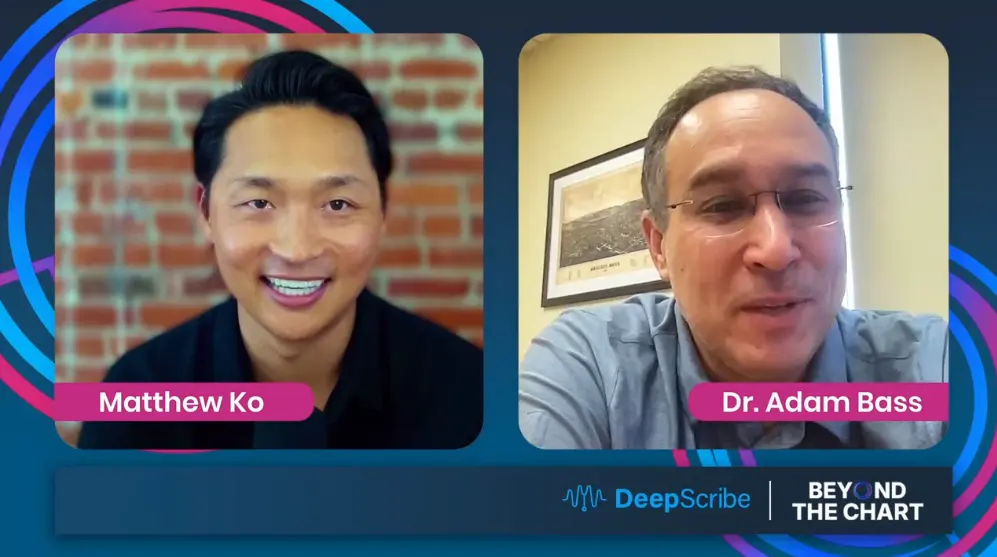
Across the practice and study of oncology, combining work or data can drive positive outcomes. Then why is the single idea so often rewarded? That’s just part of the conversation between DeepScribe CEO and founder Matthew Ko and physician-scientist Adam Bass, MD, of Memorial Sloan Kettering Cancer Center.



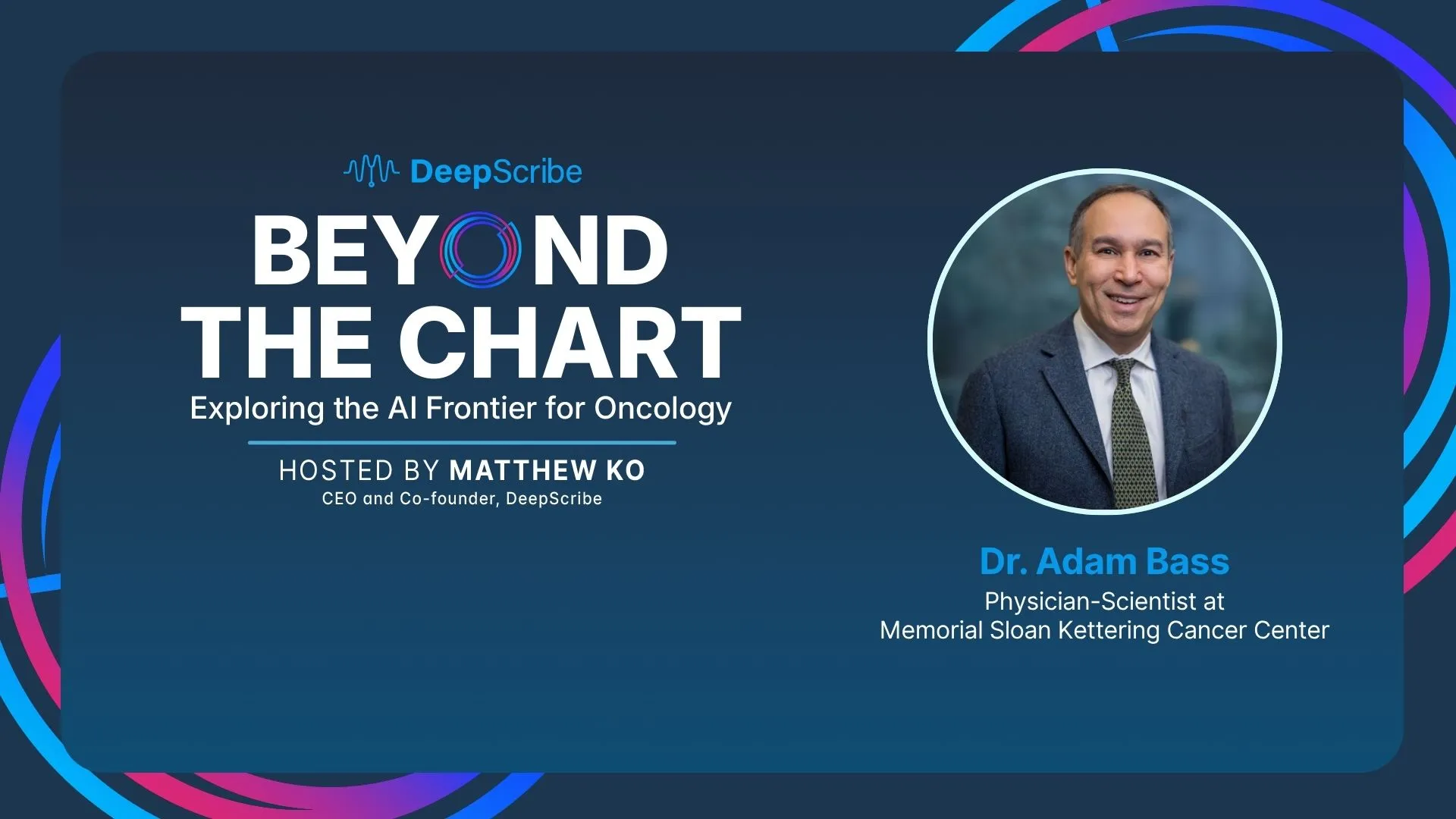
Beyond the Chart Podcast Guest
Adam Bass, MD
Physician-Scientist, Gastrointestinal Oncology Service and the Gastroesophageal Cancer Therapeutics Accelerator (GCTA), Memorial Sloan Kettering Cancer Center; former Global Head of Oncology Translational Research, Novartis; led genomic characterization of gastroesophageal cancers for The Cancer Genome Atlas
Key Insights
- Cancers without a single dominant target are where oncology has struggled most.
Dr. Bass draws a distinction between diseases where researchers find one transformative therapy to build around and the much larger group where no target dominates. A recent example of the former is the KRAS-targeted breakthrough in pancreatic cancer after decades as oncology's classic hard-to-drug target. - Following a guideline and following the evidence aren't always the same decision.
Dr. Bass describes a young mother with recurrent, HER2-positive gastroesophageal cancer where no trial data existed for her exact situation. The final call came down to what she could live with, not what the literature said. - AI's biggest opportunity in oncology may be to stop simplification.
Measures like performance status and response criteria exist because people need to compress complexity into something they can share and act on. AI doesn't need that compression, and could let researchers work with the real messiness of cancer biology instead of reducing it. - The research culture in oncology often rewards a single narrative over combining what already works.
Funding and publication incentives tend to favor one focused hypothesis, even when the more useful work is figuring out how existing findings fit together. - The physician-scientist may be uniquely positioned to bridge lab precision and clinical details, but there’s no infrastructure for it.
The generation trained to isolate single variables in clean models now needs to hold that discipline alongside an actual patient in front of them. It’s a balance that Dr. Bass says medicine hasn't figured out how to support.
Why doesn’t more genomic knowledge lead to more treatments?
Dr. Bass helped lead the Cancer Genome Atlas work that mapped the genomic landscape of gastric and esophageal cancer. The research revealed that a single disease was actually several diseases with meaningfully different biology.
For some subtypes, that map led directly to treatment. Cancers with microsatellite instability, for instance, turned out to respond well to newer immunotherapies once researchers understood what made them different.
"Cancer is the ultimate manifestation of evolution and adaptability. It finds ways around problems. You could draw the most beautiful outline of a pathway on the chalkboard, the cancer doesn't care."
But the largest group of gastric cancers, those with chromosomal instability, tell a different story. Researchers can now see which genes are activated and even have drugs that block them, but turning that knowledge into working therapies has proven far harder than expected.
Dr. Bass is candid about the gap. The field’s few outlier successes have been built around a single target, and have been so effective it changes the standard of care. But most cancers don't offer that kind of target. For those, the twenty-year trendline shows incremental gains — an added drug here, a resequencing of treatment there — rather than transformation.
When should an oncologist follow the treatment guideline, and when should they break from it?
To answer this question, Dr. Bass walks through a case: A young, healthy woman with three kids had been treated for early esophageal cancer and responded very well. Three and a half years later, a single metastasis showed up in her brain. Surgeons removed it, she had radiation afterward, and no visible cancer remained. But the tumor that came back had tested strongly HER2-positive.
"There will always be a limit to evidence-based medicine, because there are certain things we'll never have enough data for."
For this exact situation, there was no clinical trial data to support giving her additional therapy. There was only a reasonable inference from HER2-positive breast cancer research, where a related drug is known to cross the blood-brain barrier.
What’s the next step? Some of Dr. Bass’s colleagues wouldn't have chosen additional treatment without data to support it. Dr. Bass had a different approach.
He told the patient about the admitted gap in the evidence, and asked her what she could live with. For her, doing everything possible wasn't optional. But for another patient in a similar spot, holding back might have been the right call instead.
Even as digital pathology and AI make it possible to attach a specific recurrence-risk percentage to a case like this patient’s, Dr. Bass fully expects the judgment call to remain.
Why does oncology's research culture reward narrow discovery over a combination of what already works?
Dr. Bass sees this as almost a cultural default in oncology research, where everyone is looking for the one target so compelling it "changes the whole world." That instinct makes sense, as it’s reinforced by how science gets funded and published.
A tight, well-told story wins a grant application; a story that describes how several existing findings might combine doesn't compete as well, even when it's the more honest description of the biology.
"Imagine you have a potluck, and everyone brings forks, knives, and cups. No one brings the food because everybody's sort of doing their own thing."
Dr. Bass explains the result is a field full of people bringing their own specialized piece to the table without checking whether all the pieces fit together. For instance, five drugs that each kill the same 40% of a tumor could leave the same resistant 60% untouched because no one checked whether the drugs were complementary or redundant. Dr. Bass connects this to a concept called orthogonality, in which therapies are designed to work on the parts of a tumor that resist each other, rather than the same vulnerable slice twice.
How could AI help oncology move past reductive categories instead of adding to them?
One of the more surprising threads in the conversation centered on why oncology relies heavily on simplified categories like performance status or standard response criteria. Matt and Dr. Bass point to people needing to reduce an enormously complex reality into something they can communicate and act on.
"One way I think about AI is how it can help us redefine the phenotype: It can identify patterns and signals and connections that our brains couldn't."
AI systems don’t share that constraint, as Matt points out. They don’t need human-legible categories to find patterns, and forcing AI technology to communicate as humans do may actually limit what it can find.
That reframes what Dr. Bass is most excited about within digital pathology: tools that can hold onto the full spatial complexity of a tumor, including how a target is distributed across cells, and whether it's clustered or scattered. Current methods simply reduce the read to a single number.
What does the role of physician-scientist look like as AI takes on more of the cognitive work?
Dr. Bass traces today’s physician-scientist role back to a model from a different era. When researchers didn’t yet have tools to study cancer biology directly in people, they would run a lab most of the week and see patients the rest. Dr. Bass says that, with AI, a version of that model is being tested now. The discipline of isolating a single variable in a clean lab model has to coexist with the reality of a patient whose disease doesn't align with any one hypothesis.
However, the infrastructure to support this combination — funding, team structure, career paths — has yet to be built.
"I'm not worried that we'll be out of a job because of these tools. But I think they could let us do it a lot better."
Matt connects this to one of the clearest benefits of ambient documentation: When ambient AI takes note-taking out of a visit, physicians describe placing their full attention on the patient in front of them, sometimes noticing something they would have otherwise missed.
This throughline of combining resources for a greater result runs through the entire podcast. The collaboration could be oncologist and radiologist, or physician-scientist and data model.
Asked what he'd want technologists to understand about oncology, Dr. Bass points to something like clinical instinct, a sense for when a patient's biology isn't behaving the way it's "supposed to." Asked what oncologists should ask of technology builders, he’s looking for tools that help clinicians and scientists ask better questions of their own data, rather than just examining a tool’s conclusion.
Subscribe to Beyond the Chart to be notified of future episodes.
Learn about DeepScribe’s ambient AI built for oncology.
You may also like:
The Missing Data That Could Change Oncology with Dr. Caroline Chung
AI's Role in Rebooting Oncology with Dr. Douglas Flora
text
Related Stories
Realize the full potential of Healthcare AI with DeepScribe
Explore how DeepScribe’s customizable ambient AI platform can help you save time, improve patient care, and maximize revenue.