How AI Can Help Oncologists Deliver More Consistent Guideline-Based Care with Dr. Boris Pasche
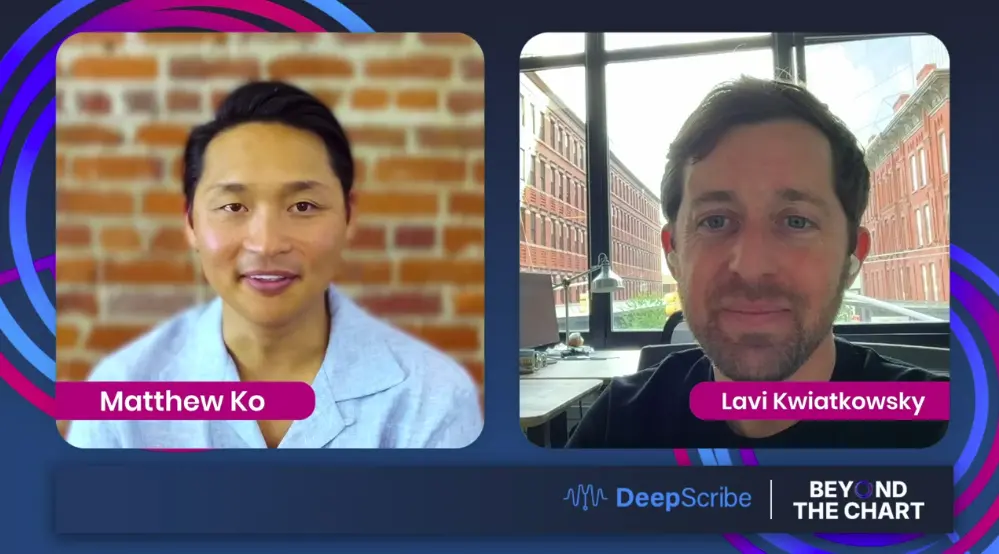
Dr. Boris Pasche joins DeepScribe founder and CEO Matthew Ko to discuss a novel cancer therapy he helped create, gaps in today’s guideline-based care, and practical applications of clinical AI in oncology.


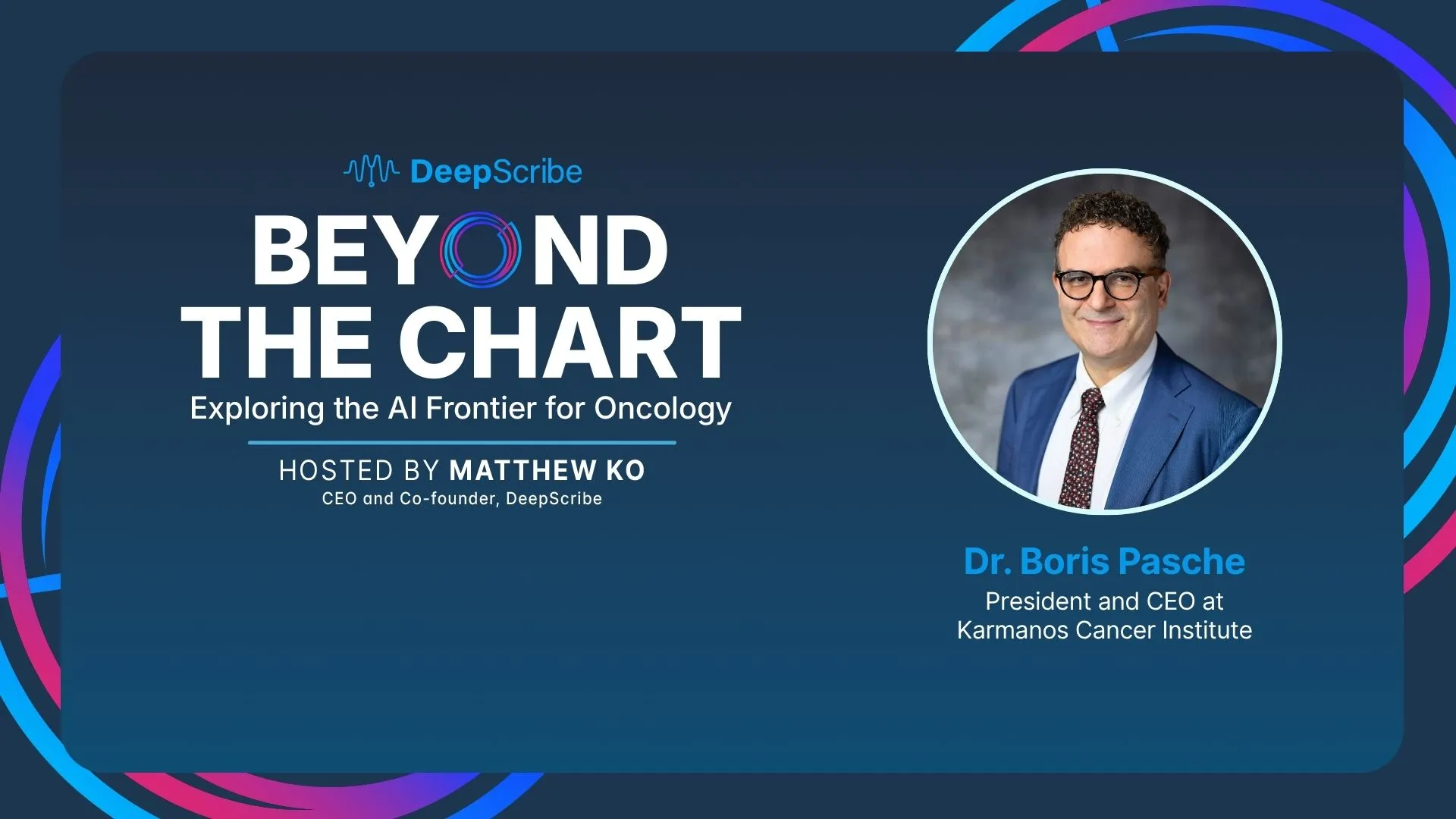
Beyond the Chart Podcast Guest
Boris Pasche, MD, PhD
President and CEO, Karmanos Cancer Institute
Chair of Oncology, Wayne State University School of Medicine
Co-founder, TheraBionic, Inc.
Key Insights
- A promising cancer therapy needs patient-centered engineering as much as scientific evidence.
Dr. Pasche’s experience shows how device usability and safety refinements become part of the path from an initial idea to clinical use. - Evidence changes outcomes only when it reaches the patient in time.
Dr. Pasche shares the story of a patient who didn’t receive immunotherapy although it was a relevant treatment, and how difficult it can be to act on evidence once a patient’s condition has worsened. - AI can make existing clinical data more useful.
The conversation’s imaging examples—from mammography and pathology to incidental findings on CT scans—show how pattern recognition may support interpretation and follow-up. - Oncology decision support should connect tumor biology with a specific care option.
AI could help clinicians relate a patient’s molecular findings to current guidelines or a relevant trial as the evidence evolves. - AI’s clinical value depends on the workflow and information around it.
DeepScribe founder Matthew Ko and Dr. Pasche connect useful decision support to a good workflow fit and better communication across systems.
What drives a clinician to develop a new cancer therapy?
For Dr. Pasche, the drive to develop better cancer treatments is deeply personal. As a medical student, he lost his brother to acute myeloid leukemia. Soon afterward, encounters with young patients facing terminal cancer made it clear that oncology was where he needed to focus his career.
“I realized this is really affecting me so profoundly, this is where I should go. I should not go into coagulation, but I should go into cancer.”
That experience led Dr. Pasche toward a question that remains central to cancer research: Can treatment be both effective and less burdensome for patients? In his work developing a novel radiofrequency electromagnetic-field treatment approach, the goal was to explore a different way to target tumors while avoiding many of the toxicities associated with traditional therapies.
How does a novel cancer therapy go from concept to patient care?
A compelling idea is only the starting point. Bringing a new treatment into clinical use requires years of evidence generation, device or therapy refinement, clinical trials, and regulatory engagement.
“We have identified a novel approach to treat cancer, refining its mechanism of action … to better understand how to combine this approach with already approved drugs.”
Dr. Pasche describes to Matt how his TheraBionic therapy evolved from early observations into a device designed for safe, at-home use. The team improved how treatment contact could be monitored, created a way to track prescribed and completed treatment time, and separated the treatment device from its charging station to reduce safety risks.
After FDA authorization, the work continued. As the team learned more about the therapy’s mechanism of action, it began investigating which drugs could interfere with its effects and which combinations could be promising.
Why do guideline-based treatments sometimes fail to reach patients?
Dr. Pasche shared the story of a patient with recurrent rectal cancer whose tumor characteristics suggested that immunotherapy could be an appropriate treatment. While receiving care elsewhere, the patient had not been offered immunotherapy and had been sent home to hospice.
After seeking a second opinion, Dr. Pasche recommended immunotherapy, but getting the patient treated while he was hospitalized required him to push through barriers around inpatient acceptance and reimbursement. After starting treatment, the patient’s disease began to respond.
“Suddenly, the situation turned around. So we’re not talking about funerals, we’re talking about long-term survival.”
Matt connected the case to a growing challenge for oncology teams that’s been discussed often on Beyond the Chart: Guidelines change quickly. Biomarker-driven treatment options continue to expand. Clinical trials are opening across disease states and geographies. Even the most highly skilled clinicians can struggle to synthesize every relevant development for every patient.
The conversation points to a practical role for decision support: helping clinicians see when a patient’s tumor characteristics may align with an established treatment option.
For more, see Matthew Ko's Precision Oncology Has a Coordination Problem
In what areas of oncology is AI already creating clinical value?
Dr. Pasche points to image interpretation as an area where AI is already being applied. In mammography, models trained on images known to be positive or negative can help characterize whether a lesion is more likely to be benign or malignant. In pathology, AI may assist when a biopsy is equivocal—for example, when pathologists are determining whether a finding is a tumor or what grade it should receive.
“The applications really are endless. They are particularly helpful when you have repetitive work that could lead to human error.”
He also described a program across McLaren Health Care that uses existing CT scans to identify patients with high coronary calcium scores. Those patients can then be contacted and encouraged to follow up with a clinician. It is a cardiovascular example rather than a cancer-treatment use case, but it shows how AI can surface a finding from imaging already performed and then connect it with a next step for the patient.
How can AI help oncology teams keep up with changing evidence?
With new biomarker-driven therapies, treatment guidelines, and clinical trials, keeping up with the full scope of oncology knowledge as a working clinician is overwhelming, if not impossible. That challenge is especially acute for general oncologists who care for patients across numerous tumor types.
Dr. Pasche sees an opportunity for AI to help connect a patient’s tumor biology with relevant guidelines, available therapies, and potential trials. Rather than asking clinicians to navigate separate tools or sift through fragmented data, well-designed clinical AI could bring context into the electronic medical record and the point of care.
“It’s virtually impossible for a physician to reread everything every time. But… quite helpful to have AI tools that are reminders that help you grasp the full history of a patient over the course of their diagnoses and treatments.”
Matt has shared this same vision (now applied and available in pre-visit intelligence with SmartPrep) and noted that this is where AI becomes more than a productivity tool. The greatest potential lies in making clinical intelligence available within the workflows oncology teams already use, to help them synthesize a patient’s history, surface relevant treatment considerations, and act on insights more reliably.
Why is interoperability crucial for the future of AI in oncology?
In a specialty as naturally complex as oncology, clinical context across workflows is essential. Yet cancer care data is often spread across disparate medical record sources, imaging systems, sites of care, and patient portals.
Dr. Pasche identifies this fragmentation as a major barrier to realizing AI’s full potential. Ideally, patients and clinicians shouldn’t have to navigate multiple systems to reconstruct patient history—without seamless connection, even the most capable AI model will have incomplete context.
He gave a simple concrete example of the problem: Some patients’ records sit in different EHR systems, and patients may need to bring a phone to a consultation to show data from another system.
“They [patients] need their cell phone at the consultation to be able to show you the data from the other system. That doesn’t make sense in this day and age.”
He called communication among systems a prerequisite for progress and said government intervention may be needed because he does not expect EMR providers to solve interoperability on their own. Matt described fragmented and differently structured data as a bottleneck: AI needs relevant information in a coherent context to be useful. Their discussion makes interoperability a practical concern for applying AI in oncology.
Explore More From Beyond the Chart: Exploring the AI Frontier for Oncology
Beyond the Chart features timely conversations with oncology leaders, clinicians, researchers, and innovators working to improve the future of cancer care.
Subscribe to the podcast for more perspectives on how AI is impacting oncology today, and how it should in the future.
You may also like:
Awakening an Experimental Spirit for Oncology with Dr. Sean Khozin
The Physician-Scientist in Oncology's AI Era with Dr. Adam Bass
text
Related Stories
Realize the full potential of Healthcare AI with DeepScribe
Explore how DeepScribe’s customizable ambient AI platform can help you save time, improve patient care, and maximize revenue.